Getting a fast reply to an email deserves more than a generic “thanks.” Whether you’re emailing a client, coworker, recruiter, or customer support team, the way you acknowledge a quick response can strengthen the relationship and make your communication feel more genuine. This guide breaks down dozens of alternatives to the overused phrase, organized by tone and situation, so you always have the right words ready.
Why “Thank You for Your Quick Response” Sounds Overused
The phrase itself isn’t wrong — it’s just everywhere. Customer support teams, sales reps, and job seekers use it so often that it can come across as mechanical rather than sincere. When you swap in a more specific or personal phrase, your message feels warmer and shows you actually noticed the effort behind the fast reply.
Using varied phrasing also helps in a few practical ways:
- It avoids sounding like a copy-paste template
- It matches the tone of the relationship (formal vs. casual)
- It can make follow-up emails feel more natural
- It shows genuine appreciation instead of a scripted response
When Should You Thank Someone for a Quick Response?
Not every reply needs a thank-you, but certain situations call for it:
- Customer support interactions – when a rep resolves your issue fast
- Job applications – when a recruiter replies sooner than expected
- Business inquiries – when a vendor or partner responds same-day
- Team communication – when a coworker helps you meet a deadline
- Sales conversations – when a lead responds quickly to your outreach
In each case, a short, specific thank-you helps keep the conversation moving smoothly.
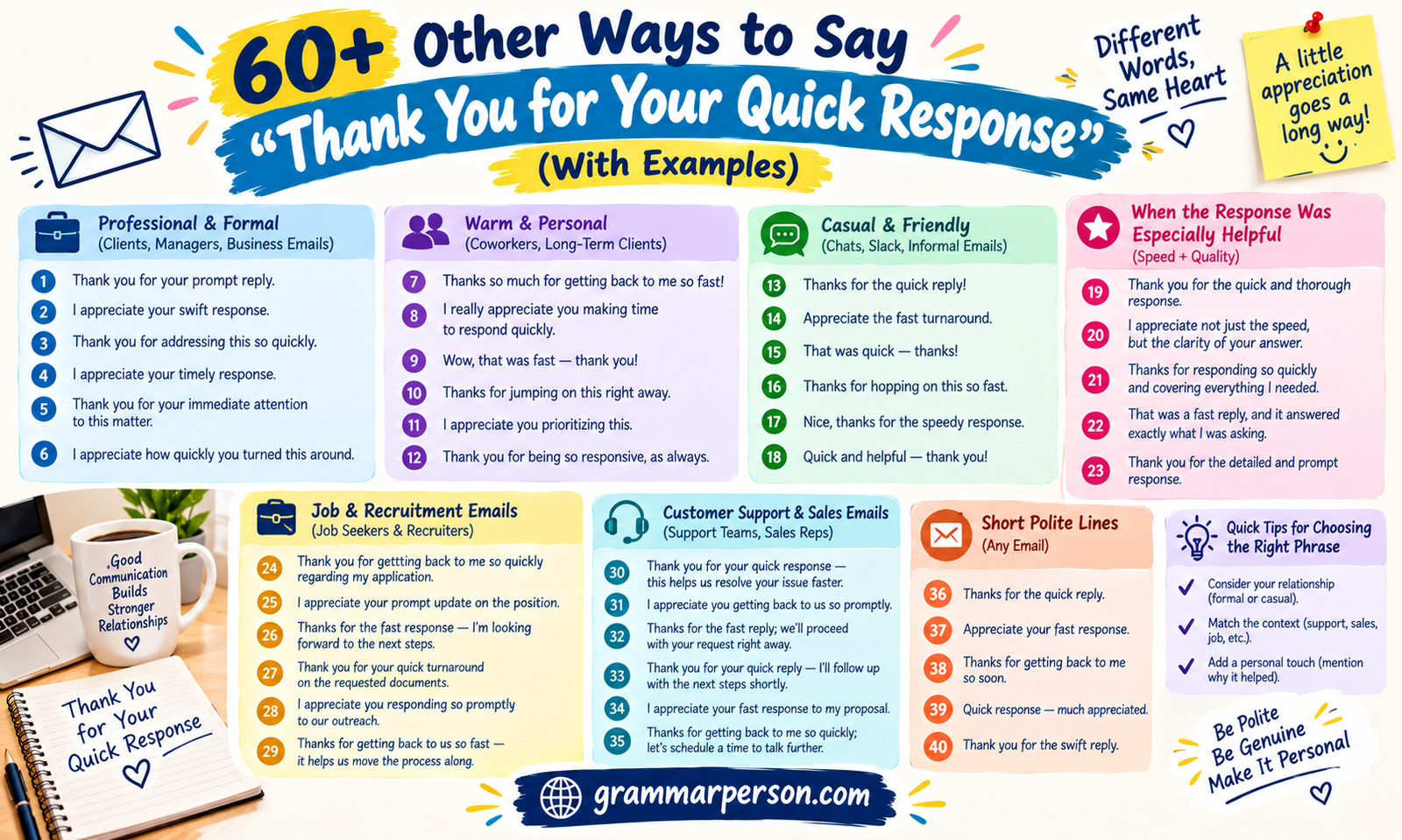
Professional and Formal Alternatives
Use these when emailing clients, managers, or anyone in a formal business setting.
| Phrase | Best Used For |
|---|---|
| “Thank you for your prompt reply.” | General business emails |
| “I appreciate your swift response.” | Client communication |
| “Thank you for addressing this so quickly.” | Support or issue resolution |
| “I appreciate your timely response.” | Formal follow-ups |
| “Thank you for your immediate attention to this matter.” | Urgent requests |
| “I appreciate how quickly you turned this around.” | Project deadlines |
These phrases work well in emails where professionalism matters most, such as client updates or executive communication.
Warm and Personal Alternatives
These options add a friendlier tone without losing professionalism — ideal for coworkers or long-term business relationships.
- “Thanks so much for getting back to me so fast!”
- “I really appreciate you making time to respond quickly.”
- “Wow, that was fast — thank you!”
- “Thanks for jumping on this right away.”
- “I appreciate you prioritizing this.”
- “Thank you for being so responsive, as always.”
This tone works best with people you already have a rapport with, like teammates or regular clients.
Casual and Friendly Options
For internal chats, Slack messages, or informal email threads, shorter and more relaxed phrasing fits better.
- “Thanks for the quick reply!”
- “Appreciate the fast turnaround.”
- “That was quick — thanks!”
- “Thanks for hopping on this so fast.”
- “Nice, thanks for the speedy response.”
- “Quick and helpful — thank you!”
When the Response Was Especially Helpful
Sometimes speed isn’t the only thing worth acknowledging — the quality of the answer matters too. These phrases combine both.
- “Thank you for the quick and thorough response.”
- “I appreciate not just the speed, but the clarity of your answer.”
- “Thanks for responding so quickly and covering everything I needed.”
- “That was a fast reply, and it answered exactly what I was asking.”
- “Thank you for the detailed and prompt response.”
Alternatives for Job and Recruitment Emails
Job seekers and recruiters both benefit from varying their language, since this phrase appears constantly in hiring communication.
For job applicants replying to recruiters:
- “Thank you for getting back to me so quickly regarding my application.”
- “I appreciate your prompt update on the position.”
- “Thanks for the fast response — I’m looking forward to the next steps.”
For recruiters replying to candidates:
- “Thank you for your quick turnaround on the requested documents.”
- “I appreciate you responding so promptly to our outreach.”
- “Thanks for getting back to us so fast — it helps us move the process along.”
Alternatives for Customer Support and Sales Emails
Support teams and sales reps often send high volumes of similar emails, so varied phrasing helps messages feel less templated.
Customer support replies:
- “Thank you for your quick response — this helps us resolve your issue faster.”
- “I appreciate you getting back to us so promptly.”
- “Thanks for the fast reply; we’ll proceed with your request right away.”
Sales and business development:
- “Thank you for your quick reply — I’ll follow up with the next steps shortly.”
- “I appreciate your fast response to my proposal.”
- “Thanks for getting back to me so quickly; let’s schedule a time to talk further.”
Short Polite Lines You Can Drop Into Any Email
When you need something brief but still courteous, these one-liners work almost anywhere:
- “Thanks for the quick reply.”
- “Appreciate your fast response.”
- “Thanks for getting back to me so soon.”
- “Quick response — much appreciated.”
- “Thank you for the swift reply.”
How to Choose the Right Phrase
Picking the best wording comes down to three quick checks:
- Consider your relationship. Formal for clients and executives, casual for teammates.
- Match the context. Support tickets, sales emails, and job applications each have slightly different norms.
- Add a personal touch when possible. Mentioning why the fast response helped makes the thank-you feel more genuine than a generic line.
Common Mistakes to Avoid
- Overusing the same phrase in every email, which can feel robotic
- Being too formal in casual internal chats, which can feel stiff
- Forgetting to mention the next step, leaving the conversation hanging
- Adding too much flattery, which can come across as insincere
A good thank-you is short, specific, and matched to the tone of the conversation.
FAQs
1. Why shouldn’t I just say “thank you for your quick response” every time?
Repeating the same phrase can sound scripted; varying your wording keeps emails feeling genuine and personal.
2. What’s the best way to thank a coworker for a fast reply?
Keep it casual and specific, such as “Thanks for jumping on this so quickly — really helped me out.”
3. Is it okay to use casual phrases in professional emails?
Yes, as long as the relationship supports a relaxed tone, like with familiar coworkers or long-term clients.
4. Should I thank someone for every quick email reply?
Not necessarily — save it for replies that genuinely help you move forward or solve a problem.
5. What’s a good short alternative for busy professionals?
“Thanks for the quick reply” or “Appreciate your fast response” work well when you need something brief but polite.
Conclusion
A simple thank-you can go a long way in professional communication, but it works even better when it doesn’t feel like a template. Whether you’re emailing a client, a recruiter, or a coworker, choosing a phrase that matches the tone and context of your relationship makes your appreciation feel authentic. Keep a few of these alternatives on hand, and your emails will always sound thoughtful — never repetitive.

Mr Danish Ali is an English grammar enthusiast who creates clear, practical, and easy-to-understand content at GrammarPerson, helping learners improve grammar, writing, sentences, and communication skills.