
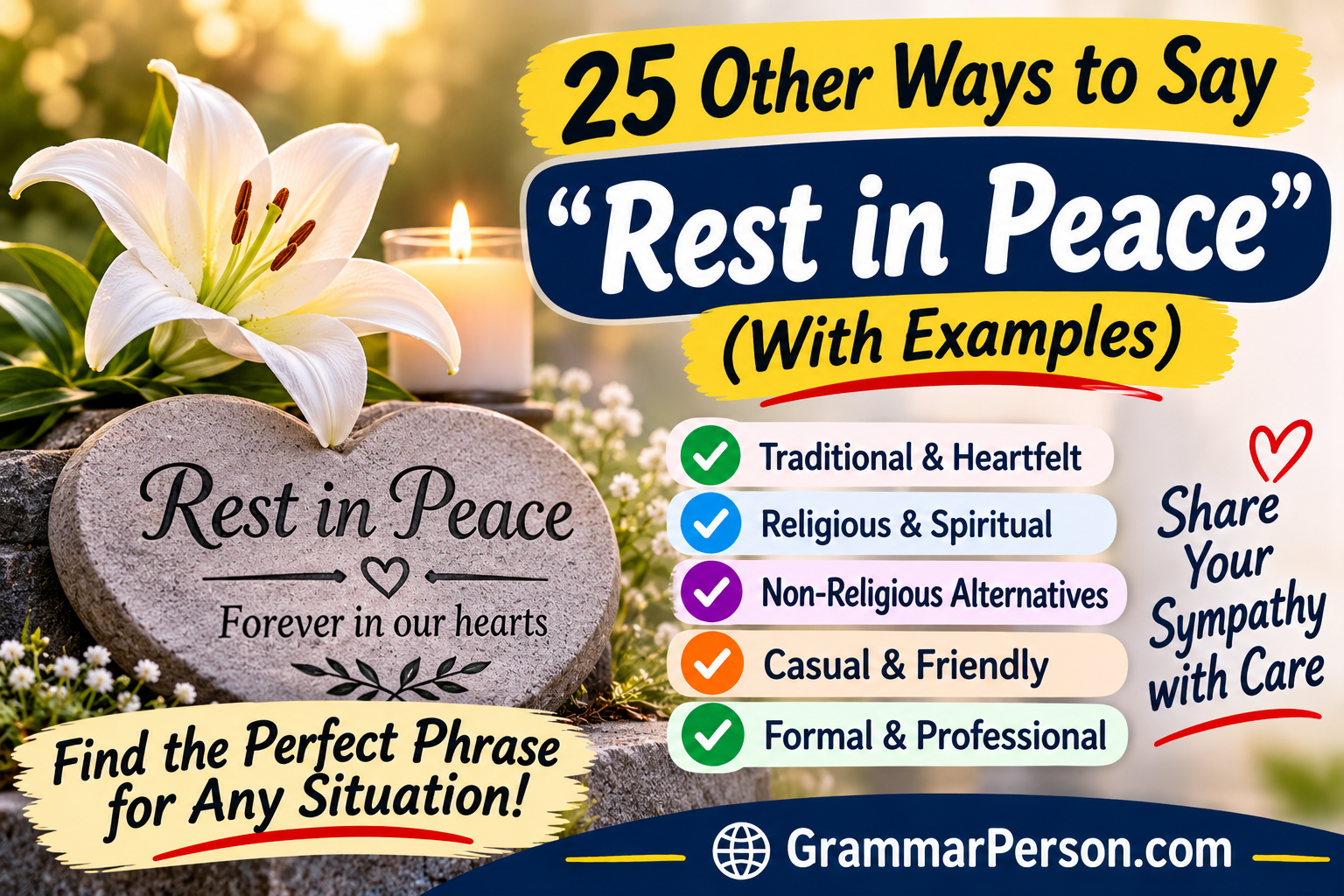
“Rest in peace” is a familiar way to honor someone who has died. But it can feel short or routine when you want to comfort a grieving friend or write a heartfelt tribute.
This guide gives you 25 other ways to say “rest in peace.” You’ll learn which phrases are religious, which are secular, and which fit sympathy cards, social media posts, and workplace messages.
What Does “Rest in Peace” Mean?
“Rest in Peace” (often written RIP) is a farewell wish for someone who has passed away. It expresses the hope that they are now free from pain and at peace.
The phrase comes from the Latin requiescat in pace and has long been used in Christian traditions, on headstones, and in prayers.
When to Use “Rest in Peace”
You can use it in many situations:
- In a sympathy card or condolence message
- In a social media tribute or comment
- On a memorial page or funeral program
- In a short text to a grieving friend
It works well when you want to be brief. For a close loss, a longer and more personal message usually feels more caring.
Pros and Cons of “Rest in Peace”
| Pros | Cons |
|---|---|
| Widely known and understood | Can feel generic or automatic |
| Short and respectful | Has religious roots, which may not suit everyone |
| Works online and in print | May seem too brief for a close loss |
| Safe when you are unsure what to say | Overused in comment sections |
Why Use Alternatives to “Rest in Peace”?
The right words show you truly care. A personal message can bring more comfort than a short, familiar phrase.
Alternatives also help you:
- Match the person’s beliefs and culture
- Sound sincere rather than scripted
- Fit the setting, from a card to a workplace notice
- Honor the memory of a loved one in a more meaningful way
Traditional and Heartfelt Ways to Say “Rest in Peace”
Use these in sympathy cards, funeral messages, and tributes to family members.
- In loving memory. “In loving memory of a kind and generous father.”
- Forever in our hearts. “Forever in our hearts, dear Grandma.”
- Gone but never forgotten. “Gone but never forgotten. We miss you every day.”
- Always remembered. “Always remembered by everyone who knew you.”
- Forever loved. “Forever loved and deeply missed.”
- Farewell with love. “Farewell with love, until we meet again.”
Religious and Spiritual Alternatives
These suit families who share a faith. Check the person’s beliefs first if you are unsure.
- May your soul find peace. “May your soul find peace in God’s care.”
- Peace be with you. “Peace be with you, dear friend.”
- Safe in God’s arms. “Safe in God’s arms at last.”
- May you rest in eternal light. “May you rest in eternal light and love.”
- In eternal rest. “Now in eternal rest, free from pain.”
- Rest in heaven. “Rest in heaven, Aunt Rose.”
Non-Religious and Secular Alternatives
These work for people of any belief, or none. They focus on memory, love, and legacy.
- At peace now. “At peace now, and free from pain.”
- Your memory lives on. “Your memory lives on in all of us.”
- Your legacy lives on. “Your legacy lives on through your students.”
- Always in our thoughts. “Always in our thoughts, today and every day.”
- Thinking of you always. “Thinking of you always, my dearest friend.”
- You will be missed deeply. “You will be missed deeply by your whole team.”
Gentle and Casual Alternatives for Friends
Use these for friends or peers, in texts or social posts.
- Rest easy. “Rest easy, my friend.”
- Sleep peacefully. “Sleep peacefully. You earned it.”
- Gone too soon. “Gone too soon, but never forgotten.”
- May you find rest. “May you find rest after such a long journey.”
- In peaceful slumber. “In peaceful slumber now, with no more pain.”
Formal and Professional Alternatives
At work, keep your tone respectful and calm. Avoid religious wording unless you know it is welcome.
- With deepest sympathy. “With deepest sympathy to the family during this difficult time.”
- Rest in paradise. “Rest in paradise, dear colleague.”
For a sample workplace message, you could write: “We are deeply saddened by the passing of Maria. She will be greatly missed by our team.” That wording fits company emails and announcements.
For another long list of options, see this collection of 100 other words for RIP.
Quick Comparison Table
| Phrase | Tone | Best For | Religious? |
|---|---|---|---|
| In loving memory | Formal, warm | Cards, funeral programs | No |
| Forever in our hearts | Warm | Family, close friends | No |
| May your soul find peace | Traditional | Faith-based messages | Yes |
| Safe in God’s arms | Heartfelt | Religious families | Yes |
| Your legacy lives on | Respectful | Mentors, leaders | No |
| Rest easy | Casual | Friends, social media | No |
| With deepest sympathy | Formal | Workplace, condolences | No |
| At peace now | Gentle | Long illness | No |
How to Choose the Right Phrase
Ask yourself three simple questions:
- What were their beliefs? Choose faith-based wording only if it fits.
- How close were you? Warm, personal words suit close relationships.
- Where will it appear? A card can be detailed. A comment should be short.
For more phrases grouped by relationship, you can also browse this guide to formal, informal, and professional alternatives.
Short Examples You Can Copy
Sympathy card:
“In loving memory of your mother. Please accept my deepest sympathy. She will always be remembered.”
Social media tribute:
“Gone too soon, but never forgotten. Rest easy, my friend.”
Message to a grieving friend:
“I’m so sorry for your loss. Forever in our hearts. I’m here if you need anything.”
A good message often has two parts. First, share your sympathy. Then, add a memory or an offer of support.
Common Mistakes to Avoid
- Using religious phrases for everyone. Not every family shares the same faith.
- Using casual words in formal settings. “Rest easy” may not suit a workplace notice.
- Writing “RIP” alone for a close loss. A longer message feels more caring.
- Making it about you. Keep the focus on the person and the family.
- Using humor too early. Wait until you know the family’s tone.
You can also compare ideas from this list of 25 alternatives with examples and this roundup of 25 ways to say rest in peace.
Frequently Asked Questions
What is another way to say “rest in peace”?
You can say “in loving memory,” “forever in our hearts,” or “gone but never forgotten.” All three are respectful.
Is it wrong to say “rest in peace”?
No, it is polite and widely accepted. For close losses, a more personal message may feel warmer.
What can I say instead of “rest in peace” if the person was not religious?
Try “your memory lives on” or “always in our thoughts.” These focus on love and legacy.
What is a professional way to say “rest in peace”?
Use “with deepest sympathy” or “they will be greatly missed.” Both suit workplace messages.
Can I use “rest easy” in a condolence message?
Yes, with friends and peers. For formal notes or older relatives, choose a more traditional phrase.
Conclusion
“Rest in peace” is a kind phrase, but it isn’t your only choice. With these 25 alternatives, you can offer comfort that is more personal, more respectful, and better matched to the moment.
Think about the person’s beliefs, your relationship, and the setting. Keep your words sincere and simple. A short, honest message is often the most comforting.

Mr Danish Ali is an English grammar enthusiast who creates clear, practical, and easy-to-understand content at GrammarPerson, helping learners improve grammar, writing, sentences, and communication skills.