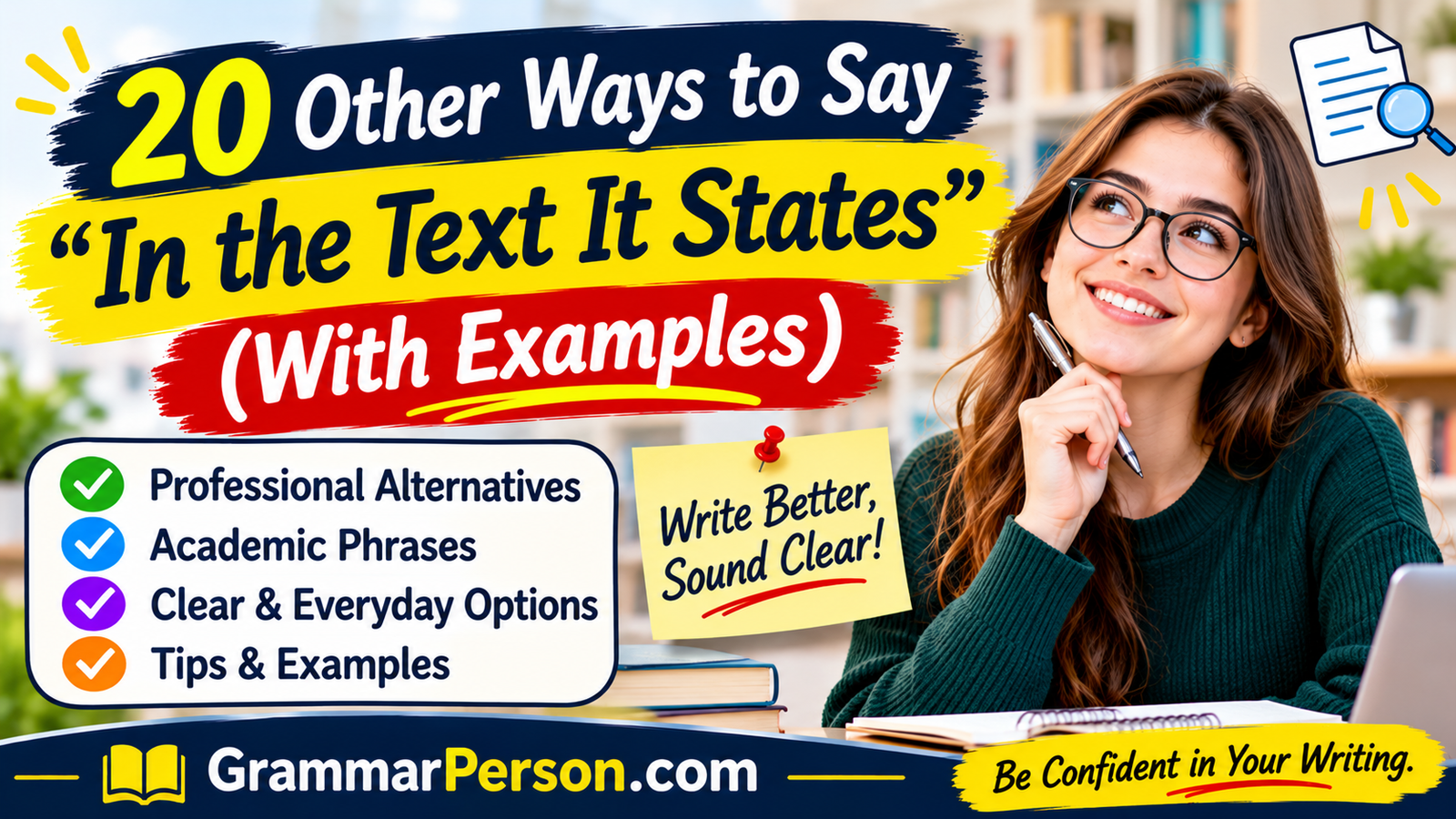
If you write essays, reports, or reading responses, you have probably typed “in the text it states” more than once. It works, but repeating it makes your writing sound flat and wordy.
This guide gives you 20 stronger alternatives, explains when each one fits, and shows real examples. By the end, you will know how to cite a source smoothly in any tone.
What Does “In the Text It States” Mean?
“In the text it states” points your reader to something written in a specific passage, article, book, or document. It tells them, “This idea comes from the source, not from me.”
Quick definition: It is a reference phrase used to attribute information to a written source.
Example: In the text it states that the experiment was repeated three times.
Why Should You Use Alternatives?
The phrase is grammatically awkward. “In the text” and “it states” both point to the same source, so the sentence feels doubled. Better options:
- Make your sentences shorter and more direct
- Add variety to your writing
- Match the tone of your audience
- Sound more confident and academic
Writing guides such as Grammar Atlas also note that varied phrasing improves readability and keeps readers engaged.
When to Use and When to Avoid It
Use it when:
- You are writing a quick reading-comprehension answer
- You are teaching or tutoring a beginner
- You need a simple, neutral reference
Avoid it when:
- You are writing a formal research paper
- You have already used it in the previous paragraph
- A more specific verb (argues, reveals, confirms) would be clearer
Is It Formal, Polite, or Casual?
It is neutral and slightly informal. It is not rude, but it lacks polish. For professional or academic work, a tighter option like “The passage indicates” sounds more refined.
20 Alternatives to “In the Text It States”
Professional and Neutral Alternatives
- According to the text: the safest, most widely accepted option.
- The text states: direct and clean. Just drop “in” and “it.”
- The passage indicates: ideal for essays and literary analysis.
- The document says: best for contracts, policies, and business files.
- The report indicates: suits research, finance, and workplace writing.
- It is stated in the text: a passive, formal variation.
Academic Alternatives
- The author states: credits the writer directly.
- The author argues: use when the writer is making a case.
- The study reveals: perfect for research-based writing.
- As highlighted in the literature: strong for dissertations and reviews.
- The excerpt states: best when quoting a short section.
- The text elucidates: advanced, for explaining complex ideas.
Clear and Everyday Alternatives
- As mentioned in the text: friendly and easy to read.
- The article points out: good for blog, news, and web content.
- The source notes: short and precise.
- The text explains: works when the source clarifies something.
- The writing suggests: use when the idea is implied, not stated outright.
Emphasis and Evidence Alternatives
- The text emphasizes: shows the point carries extra weight.
- The text confirms: use when the source backs up a claim.
- The passage reveals: adds a slightly dramatic, analytical touch.
Sites like Grammar Experts and Slang Grammar offer similar lists if you want more variations to compare.
Real Examples by Context
| Context | Weak Version | Stronger Version |
|---|---|---|
| School essay | In the text it states the hero was brave. | The passage indicates the hero was brave. |
| Business email | In the text it states payment is due Friday. | The document says payment is due Friday. |
| Research paper | In the text it states results improved. | The study reveals that results improved. |
| Blog post | In the text it states sleep boosts memory. | The article points out that sleep boosts memory. |
| Literature class | In the text it states fear drives the plot. | The author argues that fear drives the plot. |
Comparison Table of the 10 Best Alternatives
| Alternative | Tone | Best For |
|---|---|---|
| According to the text | Neutral | All-purpose use |
| The passage indicates | Formal | Essays, literary analysis |
| The author states | Neutral | Attributing claims |
| The document says | Professional | Business, legal writing |
| The report indicates | Professional | Research, workplace |
| As mentioned in the text | Friendly | Everyday writing |
| The article points out | Casual-neutral | Blogs, news |
| The study reveals | Academic | Research papers |
| The excerpt states | Formal | Short quotations |
| The text emphasizes | Analytical | Highlighting key ideas |
How to Choose the Right Phrase
Follow these steps:
- Identify your source type. Is it an article, report, book, or study?
- Match the verb to the meaning. Use argues for opinions and reveals for discoveries.
- Check your tone. Formal work needs “indicates,” while casual writing allows “points out.”
- Avoid repetition. Rotate at least three different phrases per page.
Common Mistakes to Avoid
- Using the phrase in every sentence. It makes writing feel robotic.
- Mixing up sources. Don’t write “the author states” when quoting a report.
- Overusing fancy words. “Elucidates” is great once, but not five times.
- Forgetting citations. Alternatives don’t replace proper APA, MLA, or Chicago referencing.
- Using a strong verb for a weak claim. “Proves” is risky when the source only “suggests.”
Why Writers Default to This Phrase
It feels safe. It signals that you are relying on evidence, and it is one of the first citation phrases students learn. Habit, not poor skill, is usually the cause. Academic resources such as Grammar Prime stress that building a stronger academic vocabulary is the easiest way to break that habit.
US vs. UK Usage
Both varieties of English accept these phrases. The only real difference is style: US academic writing favors “the author states,” while UK writing often prefers “the author argues” or “the passage suggests.” Spelling differences (such as emphasise vs. emphasize) are the main distinction.
Final Thoughts
“In the text it states” isn’t wrong, but it is rarely your best option. Swap it for a precise, tone-appropriate alternative and your writing becomes sharper, more confident, and more credible. Start with “According to the text” if you are unsure, then experiment with stronger verbs as you grow comfortable. As a rule, choose the verb that best describes what the source is actually doing: stating, arguing, revealing, or confirming.
FAQs
What does “in the text it states” mean?
It refers to information written in a specific source, attributing the idea to that text.
Is “in the text it states” formal or informal?
It is neutral to slightly informal, and better suited to classroom answers than formal papers.
Can I use “in the text it states” in essays?
Yes, but sparingly. “According to the text” or “The passage indicates” reads more polished.
What are better alternatives to “in the text it states”?
Try “According to the text,” “The author states,” “The passage indicates,” or “The document says.”
Why should I avoid repeating this phrase too often?
Repetition makes writing monotonous and can lower reader engagement.
Is this phrase used in professional writing?
Rarely. Professionals prefer “The report indicates” or “The document specifies.”
What tone does this phrase create?
A plain, slightly repetitive tone that sounds more instructional than authoritative.
Can ESL learners use this phrase safely?
Yes. It is easy to understand, though learners should gradually add alternatives.
What is the best alternative for academic writing?
“The author argues” or “The study reveals” is usually best, depending on the source.
Does using alternatives improve SEO writing?
Yes. Varied phrasing improves readability and lets you include related keywords naturally.

Mr Danish Ali is an English grammar enthusiast who creates clear, practical, and easy-to-understand content at GrammarPerson, helping learners improve grammar, writing, sentences, and communication skills.