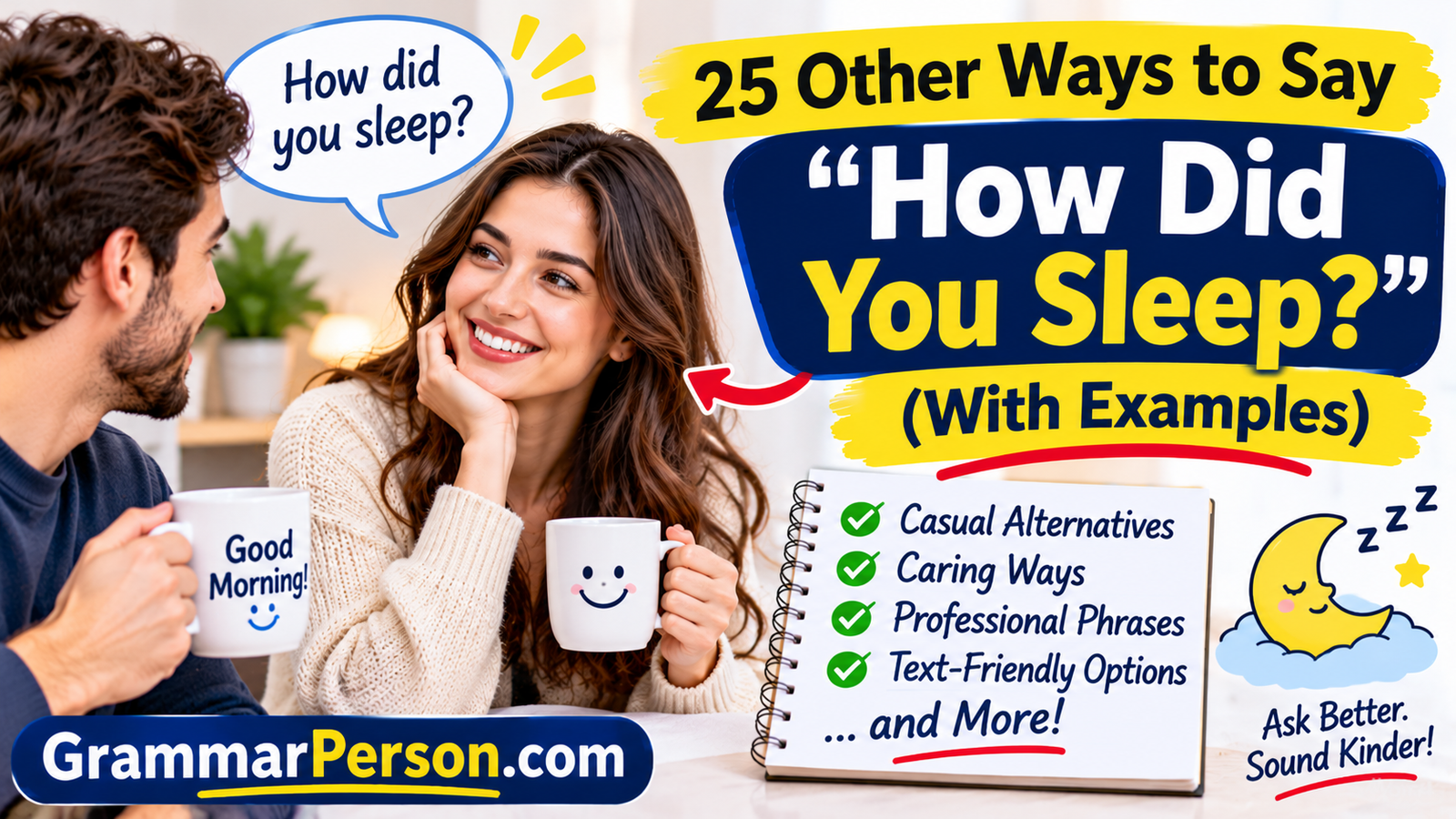
“How did you sleep?” is a warm and simple question. It shows you care about the other person. But if you ask it the same way every morning, it can start to feel automatic.
This guide shares 25 other ways to say “how did you sleep”. They are grouped by tone, so you can pick the right one for a partner, a friend, a guest, or a coworker.
What Does “How Did You Sleep?” Mean?
“How did you sleep?” asks whether someone rested well last night. It is a morning greeting that shows care and starts a friendly chat.
Example:
- “Good morning! How did you sleep?”
- “Really well, thanks. That bed is comfy!”
When Should You Use “How Did You Sleep?”
It fits best in personal, relaxed moments.
- Greeting a family member in the morning
- Checking on a guest after their first night
- Texting a friend or partner at the start of the day
In a work setting, a softer or more formal phrase usually works better.
Pros and Cons of “How Did You Sleep?”
| Pros | Cons |
|---|---|
| Warm and caring | Can feel too personal at work |
| Easy to understand | Often gets a short “fine” in reply |
| Great conversation starter | Sounds repetitive if used daily |
Why Use Alternatives?
Small changes make a question feel fresh. In my own experience helping English learners with everyday phrases, people answer more openly when the question is specific. “Did you manage to rest?” often gets a longer reply than “How did you sleep?”
Casual Ways to Ask “How Did You Sleep”
Use these with friends, family, and roommates.
- Sleep okay? – Short and relaxed. “Morning! Sleep okay?”
- How’d you sleep? – The casual, spoken form.
- Sleep good? – Very informal, best with close friends.
- How was your night? – Friendly and broad.
- Did you sleep well? – Simple and natural.
- Catch enough Z’s? – Playful and fun.
- Wake up feeling okay? – Gentle and easy to answer.
- Feeling human again? – Great after a rough week.
Caring and Warm Ways to Ask
Choose these when you want to show real concern.
- Did you get a good night’s rest? – Kind and thoughtful.
- Hope you slept peacefully. – Soft and sincere.
- Did you have sweet dreams? – Sweet, mostly for loved ones.
- How are you feeling this morning? – Shows you care about the whole person.
- Did you wake up refreshed? – Positive and upbeat.
- Was your sleep peaceful? – Calm and gentle.
- Did anything keep you up? – Good if you suspect a bad night.
Formal and Professional Ways to Ask
These suit hotels, clients, and workplace chats.
- I hope you slept well. – Polite and safe in most settings.
- Did you get some rest last night? – Neutral and respectful.
- I hope you had a restful night. – Elegant and formal alternative for guests.
- How was your night’s rest? – Smooth and courteous.
- I trust you slept comfortably. – Very formal, ideal for hosts.
- I hope you’re feeling rested this morning. – Polite for a work trip.
Text-Friendly Ways to Ask
Short and quick for messages.
- Sleep well? 😴 – Perfect for a morning text.
- Good sleep? – Brief and simple.
- Did you sleep through the night? – Useful for parents, roommates, or travel buddies.
- How’s your energy this morning? – Fresh and modern.
Quick Comparison Table
| Phrase | Tone | Best For |
|---|---|---|
| Sleep okay? | Casual | Friends, roommates |
| How was your night? | Friendly | Family, guests |
| Did you sleep well? | Neutral | Almost anyone |
| Did you have sweet dreams? | Affectionate | Partners, kids |
| I hope you slept well. | Polite | Hosts, hotel staff |
| I trust you slept comfortably. | Very formal | Formal guests |
| Sleep well? 😴 | Text-friendly | Morning messages |
| How are you feeling this morning? | Caring | Anyone who seems tired |
How to Choose the Right Phrase
Ask yourself three quick questions:
- Who am I talking to? A close friend can hear “sleep okay?” A guest should hear “I hope you slept well.”
- Where am I? Texts allow short phrases. Formal settings need full sentences.
- What do I want to know? If you care about comfort, ask about the bed. If you care about energy, ask how they feel.
A good rule from expert phrase lists is to match the closeness of your relationship. The closer you are, the shorter the question can be.
How to Reply to “How Did You Sleep?”
Many learners are not sure how to answer. Here are easy options.
- Positive: “Great, thanks! I slept like a log.”
- Neutral: “Pretty good. I woke up once or twice.”
- Honest: “Not great. I couldn’t switch off last night.”
Always return the question with “And you?” It keeps the chat balanced and polite.
Common Mistakes to Avoid
- Using slang at work. “Crash okay?” does not suit a client or manager.
- Asking too early or too often. Once a day is plenty.
- Being too personal with new people. Keep it light with acquaintances.
- Ignoring the answer. If someone says they slept badly, respond with care.
- Mixing up tenses. Say “How did you sleep?” for last night, not “How do you sleep?”
For even more phrase ideas, see this list of 31 natural alternatives for casual and caring chats.
FAQs
What does “how did you sleep” mean?
It asks whether someone rested well last night, and it is used as a friendly morning greeting.
Is “how did you sleep” correct English?
Yes, it is correct. “Did” is used because you are asking about a past event.
Is it polite to ask “how did you sleep”?
Yes, it is polite and caring, especially with family, friends, and guests.
Can I use these phrases in professional settings?
Yes, but choose formal options like “I hope you slept well” or “I hope you had a restful night.”
What is the best alternative to “how did you sleep”?
“Did you sleep well?” is the simplest and most natural replacement.
Which phrase sounds the most caring?
“Did you get a good night’s rest?” and “How are you feeling this morning?” sound warm and thoughtful.
What is the difference between “how did you sleep” and “how was your sleep”?
They mean almost the same. “How was your sleep?” sounds a little more neutral.
Conclusion
“How did you sleep?” is a lovely question, but you have plenty of ways to ask it. Use “sleep okay?” with close friends, “did you get a good night’s rest?” with people you care about, and “I hope you slept well” in formal settings.

Mr Danish Ali is an English grammar enthusiast who creates clear, practical, and easy-to-understand content at GrammarPerson, helping learners improve grammar, writing, sentences, and communication skills.