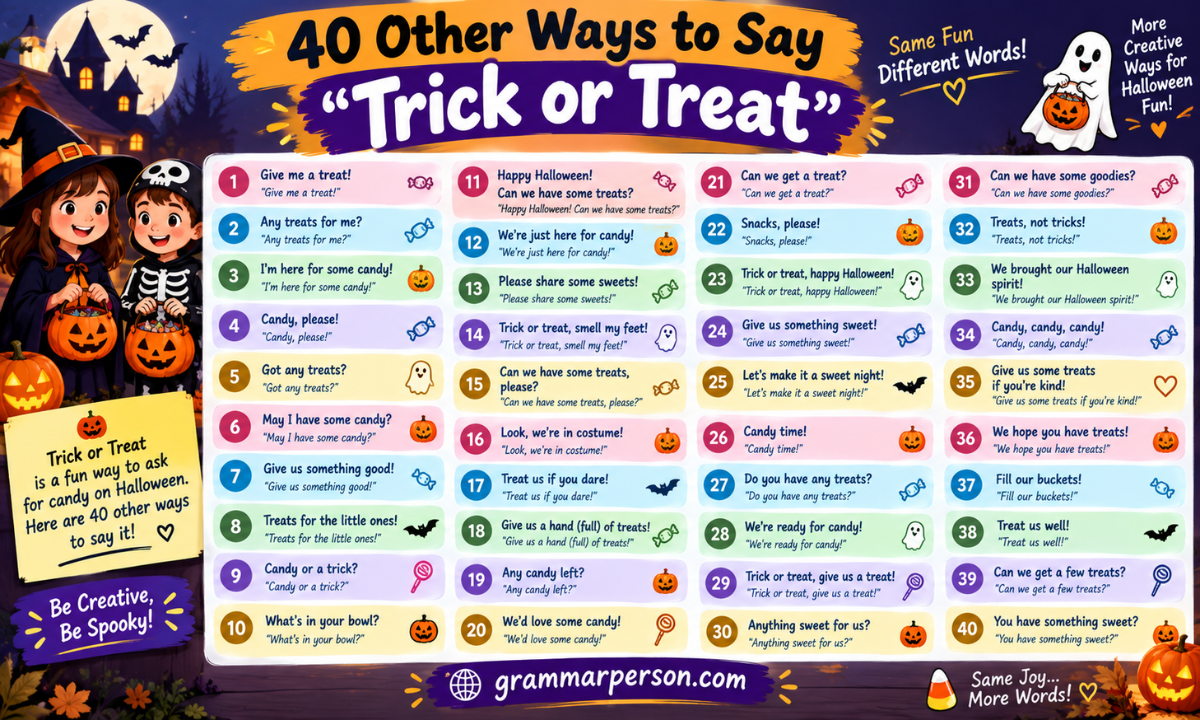
Halloween night is loud with the same three words shouted at every door: “Trick or treat!” It works, but if you’re planning a Halloween party, writing invitations, teaching kids new phrases, or just want your porch to be the memorable one this year, a few fresh alternatives can make the night more fun for everyone. Below is a complete, practical guide to other ways to say “trick or treat” — organized by tone, occasion, and age group — plus tips on when to use them.
What Does “Trick or Treat” Actually Mean?
The phrase dates back to early 20th-century North America, when children would offer a light-hearted “trick” (mischief) as an alternative if a household didn’t hand over a “treat” (candy). Over time, the trick part faded into tradition, and the phrase became a simple, cheerful request for candy. Today it functions less as a threat and more as a greeting — a Halloween-specific way of saying “hello, may we have something sweet?”
Understanding this history helps explain why so many alternatives exist. Since almost nobody expects an actual “trick” anymore, there’s plenty of room to swap the phrase for something more descriptive, funnier, or better suited to a specific crowd.
Why Look for Other Ways to Say It?
There are several practical reasons people search for alternatives to the classic line:
- Party or event themes – A costume party, school event, or neighborhood trunk-or-treat may want a phrase that matches its theme.
- Age-appropriate variety – Toddlers, teens, and adults often prefer different tones.
- Freshness – Saying the same three words all night can get repetitive for older kids and teens who go trick-or-treating for years.
- Content and marketing use – Bloggers, teachers, and party planners often need Halloween-specific phrases for invitations, games, or social captions.
- International or ESL contexts – Non-native English speakers sometimes want simpler or more descriptive phrasing.
Whatever the reason, having a list ready makes Halloween planning easier.
Quick Answer: Best Alternatives at a Glance
| Category | Example Phrase | Best For |
|---|---|---|
| Short & Simple | “Candy, please!” | Young kids, quick door visits |
| Funny & Playful | “Feed me sugar or face my werewolf howl!” | Costume parties, older kids |
| Rhyming & Cute | “Ghosts and goblins, big and small, give us candy, give us all!” | Group trick-or-treating |
| Polite | “Happy Halloween! Might we have a treat?” | Teens, formal neighborhoods |
| Creative | “Open the door, if you dare — there’s candy we’re hoping to share!” | Themed events, invitations |
More Read: grammarperson.com
Short and Simple Alternatives
These work well for younger children who are still learning the routine, or for anyone who wants a quick, easy line that still fits the Halloween spirit.
- “Candy, please!”
- “Treats, please!”
- “Happy Halloween — got candy?”
- “Sweets, please!”
- “Halloween treats, please!”
- “Candy time!”
- “Any goodies tonight?”
- “Give us a treat!”
These phrases keep the request clear while still sounding festive. They’re especially useful for toddlers who find the original phrase a bit of a mouthful.
Funny and Playful Sayings
For older kids, teens, or adults at a costume party, humor makes the ask more memorable. These lines lean into the playful side of Halloween without being mean-spirited.
- “Feed me candy before I turn into a pumpkin.”
- “I’m not a witch, but I do cast spells for chocolate.”
- “Warning: unattended candy bowls will be raided.”
- “My costume is scary, but my sweet tooth is scarier.”
- “Skeletons need sugar too.”
- “Beware — I brought my own pillowcase.”
- “This mummy is unwrapped for candy only.”
- “Ghosts get hangry. Feed us.”
These sayings tend to perform especially well at Halloween parties, school events, or on printed invitations, since they add personality without confusing younger trick-or-treaters.
Rhyming and Cute Phrases
Rhymes are popular with families and group trick-or-treating because they’re easy to say together and add a bit of theater to the doorstep visit.
- “Knock, knock, ding, ding — give us candy, that’s the thing!”
- “Ghosts and goblins, big and small, give us candy, give us all!”
- “Tonight we roam from door to door, please give us treats, we’re asking for more!”
- “Witches fly and black cats prowl, feed us candy, hear us howl!”
- “Pumpkins glow and spirits play, give us candy, come what may!”
- “Boo to you on Halloween night, hand us treats — it’s only right!”
Rhyming phrases work particularly well for younger groups since they’re fun to memorize and repeat as a chant.
Polite Phrases for Older Kids and Adults
Some neighborhoods, retirement communities, or workplace trunk-or-treat events prefer a slightly more formal approach. These alternatives keep the Halloween spirit while sounding a bit more courteous.
- “Happy Halloween! Might we have a treat?”
- “Good evening — we’re out trick-or-treating. Any candy to spare?”
- “Excuse us, could we please have some Halloween sweets?”
- “We’re collecting treats tonight — would you mind sharing one?”
- “Trick-or-treaters here — thank you for having candy ready!”
These options are especially handy for teenagers who feel a bit self-conscious about the classic three-word chant, or for adults attending an office Halloween event.
Creative Halloween Door-Knocking Lines
For families who like to make trick-or-treating a bit theatrical, or for content creators writing Halloween-themed material, these longer, imaginative lines add flair.
- “Open the door, if you dare — there’s candy we’re hoping to share!”
- “We’ve traveled through the haunted street, just to knock and ask for a treat.”
- “The moon is full, the night is bright, hand us candy, make it right.”
- “Our buckets are empty, our costumes complete — please help us fill up with something sweet.”
- “From the graveyard we have crept, only for candy, we haven’t slept.”
- “Halloween magic fills the air, give us treats to make it fair.”
These are best suited for social media captions, party invitations, or older kids who enjoy a bit of dramatic flair on the doorstep.
Tips for Choosing the Right Phrase
Picking the best alternative depends on a few simple factors:
- Know your audience. Toddlers respond better to short, simple phrases; teens and adults may prefer humor or politeness.
- Match the setting. A neighborhood street calls for something quick; a themed party allows for longer, funnier lines.
- Keep it easy to remember. Especially for young kids, a phrase that’s hard to say defeats the purpose.
- Consider the occasion. School events, church trunk-or-treats, and office parties may call for more polite wording than a rowdy neighborhood block party.
- Have fun with it. Halloween is meant to be playful — even a small twist on the classic phrase can make the night more memorable.
Sticking with “Trick or Treat”: Pros and Cons
Before swapping the phrase entirely, it helps to weigh the benefits of the traditional line against the appeal of something new.
| Traditional “Trick or Treat” | Alternative Phrases | |
|---|---|---|
| Recognition | Instantly understood everywhere | May need context, especially for young kids or non-English speakers |
| Tradition | Carries decades of cultural history | Feels fresh but less rooted in tradition |
| Fun factor | Familiar but repetitive after many houses | Adds variety and humor to the night |
| Ease of use | Extremely simple for toddlers | Some options are longer or harder to memorize |
| Best use case | General neighborhood trick-or-treating | Parties, invitations, older kids, themed events |
In short, the classic phrase remains the safest choice for door-to-door candy collecting, especially with strangers, while alternatives shine at parties, in writing, or with familiar neighbors who’ll appreciate the extra effort.
FAQs
1. What does “trick or treat” actually mean?
It originated as a playful threat — a trick if no treat was given — but today it simply means a cheerful request for Halloween candy.
2. Are these alternative phrases appropriate for young children?
Yes, especially the short and rhyming options, which are easy to memorize and just as fun to say.
3. Can adults use fun or funny Halloween sayings too?
Absolutely — playful and creative phrases are popular at adult costume parties and office Halloween events.
4. Is it rude to skip “trick or treat” and use something else?
Not at all. As long as the tone is friendly and clear, homeowners will understand you’re there for Halloween candy.
5. What’s the best alternative for a large group of trick-or-treaters?
Conclusion
“Trick or treat” isn’t going anywhere — it’s a Halloween classic for a reason. But whether you’re dressing up a neighborhood outing, writing party invitations, or just want to switch things up after years of the same three words, these 40 alternatives offer something for every age and occasion. Pick a few that match your group’s personality, practice them before the big night, and enjoy a Halloween that feels just a little more original at every door.

Mr Danish Ali is an English grammar enthusiast who creates clear, practical, and easy-to-understand content at GrammarPerson, helping learners improve grammar, writing, sentences, and communication skills.