“My name is…” is the first thing most of us learn to say in English. It’s clear and correct, but it can sound stiff or robotic once you’re past the classroom. Native speakers rarely use it in casual chats, and it can feel too plain in a networking event or job interview.
This guide covers what the phrase means, when it works, and 30 natural alternatives for casual, professional, and formal situations. Each one comes with a quick example, so you can start using it today.
What Does “My Name Is” Mean?
“My name is” is a direct, standard way to tell someone what you’re called. It works in speech and writing, and it’s usually the first line in a self-introduction.
It’s common in:
- First meetings and classroom introductions
- Phone calls and voicemails
- Forms, emails, and written bios
- Language-learning exercises
When to Use “My Name Is”
The phrase fits best when you want to be clear and straightforward. It’s a safe choice when:
- You’re introducing yourself to a group and want everyone to catch your name
- You’re speaking to someone in a second language who may need simple wording
- You’re in a formal or official setting, such as a hearing, an interview panel, or a ceremony
- You’re writing a short bio or profile where a plain statement works best
In relaxed settings, though, it may sound a little too scripted.
Is It Professional or Polite to Say “My Name Is”?
Yes, it’s polite and perfectly acceptable in any setting. It just doesn’t add much personality. In a fast-moving networking event or a friendly team meeting, a shorter or warmer option usually feels more natural.
Pros and Cons of “My Name Is”
| Pros | Cons |
|---|---|
| Clear and easy to understand | Can sound overly formal in casual chats |
| Works in any setting | Feels repetitive if used every time |
| Great for language learners | Doesn’t show personality |
| Safe for formal introductions | Less natural than what most native speakers say |
Why You Need Alternatives to “My Name Is”
Varying your introduction helps you:
- Sound more natural in everyday conversation
- Match the tone of the room, from relaxed to formal
- Add personality and make a stronger first impression
- Signal a preference, such as a nickname or a shortened name
- Avoid a scripted feel at events where you introduce yourself many times
Tips for Choosing the Right Phrase
- Read the setting. A job interview calls for a different tone than a house party.
- Think about your name. If people often mishear it or you prefer a nickname, choose a phrase that lets you say so.
- Keep it short. Long introductions lose attention fast.
- Follow with a greeting. “Nice to meet you” completes the introduction.
- Stay consistent in writing. In emails and bios, choose one style and stick to it.
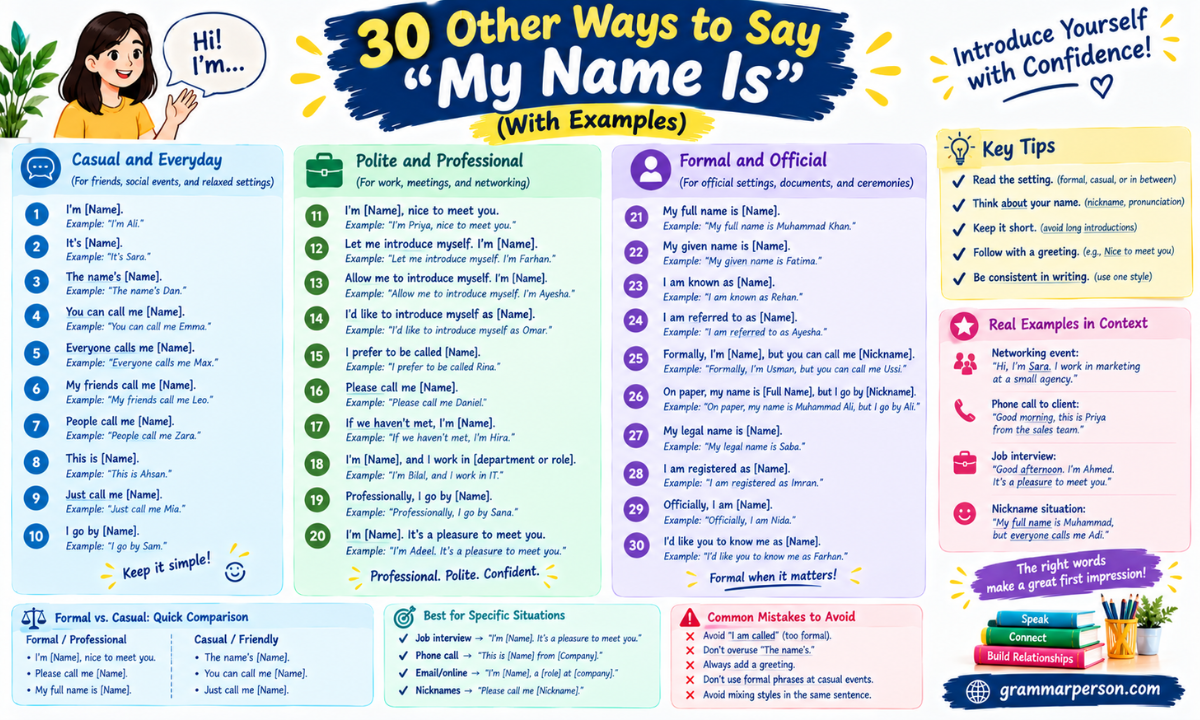
30 Other Ways to Say “My Name Is”
Casual and Everyday
- I’m [Name].
- It’s [Name].
- The name’s [Name].
- You can call me [Name].
- Everyone calls me [Name].
- My friends call me [Name].
- People call me [Name].
- This is [Name].
- Just call me [Name].
- I go by [Name].
Polite and Professional
- I’m [Name], nice to meet you.
- Let me introduce myself. I’m [Name].
- Allow me to introduce myself. I’m [Name].
- I’d like to introduce myself as [Name].
- I prefer to be called [Name].
- Please call me [Name].
- If we haven’t met, I’m [Name].
- I’m [Name], and I work in [department or role].
- Professionally, I go by [Name].
- I’m [Name]. It’s a pleasure to meet you.
Formal and Official
- My full name is [Name].
- My given name is [Name].
- I am known as [Name].
- I am referred to as [Name].
- Formally, I’m [Name], but you can call me [Nickname].
- On paper, my name is [Full Name], but I go by [Nickname].
- My legal name is [Name].
- I am registered as [Name].
- Officially, I am [Name].
- I’d like you to know me as [Name].
Quick Examples in Real Conversations
Seeing the phrases in action makes them easier to remember.
At a networking event:
“Hi, I’m Sara. I work in marketing at a small agency.”
Meeting a neighbor:
“Hey, the name’s Dan. I just moved in next door.”
Phone call to a client:
“Good morning, this is Priya from the sales team.”
Job interview:
“Good afternoon. I’m Ahmed. It’s a pleasure to meet you.”
Nickname situation:
“My full name is Muhammad, but everyone calls me Adi.”
Formal vs. Casual: Quick Comparison
| Situation | Best Phrase |
|---|---|
| Meeting a friend of a friend | “I’m [Name].” |
| Job interview | “I’m [Name]. It’s a pleasure to meet you.” |
| Phone call at work | “This is [Name] from [Company].” |
| Sharing a nickname | “You can call me [Nickname].” |
| Official forms or ceremonies | “My full name is [Name].” |
| Networking event | “Let me introduce myself. I’m [Name].” |
| Casual party | “The name’s [Name].” |
Phrases That Work Best for Specific Situations
For Job Interviews and Meetings
Keep it calm and clear. Try “I’m [Name], nice to meet you” or “It’s a pleasure to meet you, I’m [Name].” Both sound confident without being stiff.
For Phone Calls and Voicemails
“This is [Name]” is the natural choice. It’s short, clear, and standard in business calls. Avoid “My name is” on the phone unless the line is poor and you need to be understood.
For Emails and Online Profiles
Written introductions can be a little more polished. “I’m [Name], a [role] at [company]” or “Allow me to introduce myself” both read well.
For Nicknames and Name Preferences
If your name is long or often mispronounced, be direct. “I go by [Nickname]” or “Please call me [Nickname]” sets expectations politely.
Common Mistakes to Avoid
- Saying “I am called” in casual chats. It sounds formal and a bit old-fashioned.
- Overusing “The name’s.” It’s playful but can feel like a movie line in serious settings.
- Skipping the follow-up. An introduction without “nice to meet you” can feel abrupt.
- Using formal phrases at casual events. “I am officially known as…” can feel out of place at a barbecue.
- Mixing styles. Don’t say “Allow me to introduce myself” and then use slang in the same sentence.
Quick Tips to Sound More Natural
- Smile and make eye contact. Body language matters as much as the words.
- Say your name clearly and slowly. Especially if it’s unusual or hard to catch.
- Add a short detail. A role, a city, or a shared connection makes you memorable.
- Practice out loud. The phrases feel more natural after a few tries.
- Listen to the other person’s tone. Match their level of formality.
FAQs
1. Why should I use different ways to say “My name is”?
Alternatives sound more natural, help you match the setting, and make your introduction less repetitive.
2. Can I use these alternatives in casual conversations?
Yes. Phrases like “I’m [Name]” or “You can call me [Name]” are the most common in everyday chats.
3. Is “My name is” too formal?
Not really. It’s polite and clear, but many native speakers prefer shorter forms like “I’m [Name].”
4. What is the best way to introduce yourself professionally?
“Hello, I’m [Name]. It’s a pleasure to meet you” is a polished, widely accepted choice.
5. How do I tell people I prefer a nickname?
Say “Please call me [Nickname]” or “I go by [Nickname].” Both are polite and clear.
Conclusion
“My name is” will always work, but it’s rarely the only option. Whether you’re at a job interview, a networking event, or a casual get-together, one of these 30 alternatives can help you sound more natural and confident. Pick a few that match your style, practice them out loud, and your next introduction will feel effortless.

Mr Danish Ali is an English grammar enthusiast who creates clear, practical, and easy-to-understand content at GrammarPerson, helping learners improve grammar, writing, sentences, and communication skills.