“As you can see” is a handy phrase for pointing readers or listeners toward evidence, data, or a conclusion. But it shows up so often in presentations, reports, and emails that it can start to sound like filler. Whether you’re writing an academic paper, a business report, or a casual message, having alternatives ready keeps your communication sharp and varied.
This guide explains what the phrase means, when it fits, and 30 alternatives organized by tone and setting.
What Does “As You Can See” Mean?
“As you can see” points the reader or listener toward something visible or evident — a chart, a result, a pattern, or a conclusion drawn from information already shared. It signals that the next statement follows logically from what came before.
You’ll typically find it in:
- Business presentations and reports
- Academic writing and research papers
- Emails explaining data or results
- Everyday conversation when pointing something out
Is “As You Can See” Formal or Informal?
It works in both registers, which is part of why it’s so common. In formal writing, it often introduces evidence or data. In casual conversation, it’s used more loosely, even when nothing is literally visible.
Because transition words like this one function as signposts that guide the reader through your argument, overusing the same one repeatedly can weaken that guiding effect rather than strengthen it.
Is “As You Can See” Rude?
No, it’s not inherently rude. But it can sound slightly assertive if used to push a conclusion the other person hasn’t actually agreed with yet. In disagreements or persuasive writing, softer phrasing like “this suggests” or “the data indicates” can feel less confrontational.
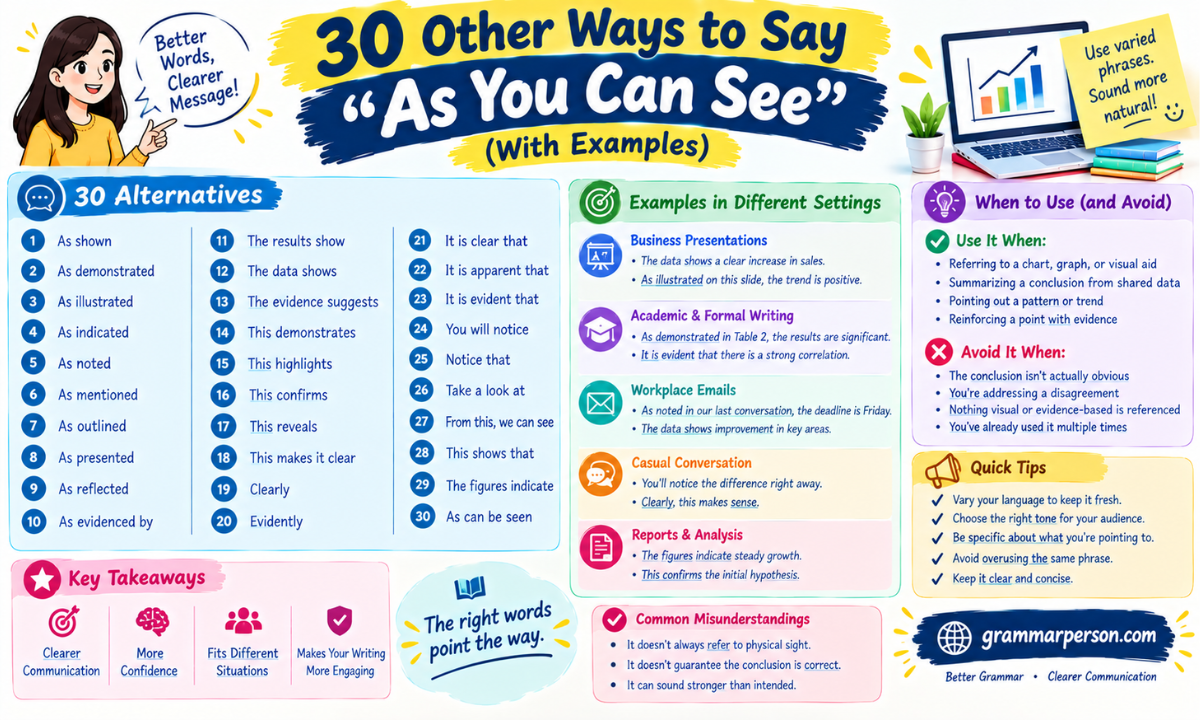
30 Other Ways to Say “As You Can See”
- As shown
- As demonstrated
- As illustrated
- As indicated
- As noted
- As mentioned
- As outlined
- As presented
- As reflected
- As evidenced by
- The results show
- The data shows
- The evidence suggests
- This demonstrates
- This highlights
- This confirms
- This reveals
- This makes it clear
- Clearly
- Evidently
- It is clear that
- It is apparent that
- It is evident that
- You will notice
- Notice that
- Take a look at
- From this, we can see
- This shows that
- The figures indicate
- As can be seen
A Few Worth Highlighting
“As demonstrated” and “as illustrated” work especially well in academic and research writing, since they point directly to evidence presented earlier in the text.
“The data shows” and “the figures indicate” are strong choices for business reports, where numbers are doing the work of persuasion.
“This makes it clear” adds a bit more confidence than the original phrase, useful when you want to emphasize a strong conclusion.
Alternatives by Setting
| Setting | Best Alternatives |
|---|---|
| Business presentations | The data shows, as illustrated, this highlights |
| Academic and formal writing | As demonstrated, as evidenced by, it is evident that |
| Workplace emails | As noted, as outlined, as mentioned |
| Casual conversation | You’ll notice, take a look at, clearly |
| Reports and analysis | The results show, the figures indicate, this confirms |
Professional Alternatives for Emails and Workplace Messages
- “As outlined in the attached report…”
- “As noted in our last conversation…”
- “The data shows a clear improvement in…”
- “As mentioned above, the results indicate…”
These options keep the tone professional while avoiding repetition across long email threads.
Alternatives for Presentations
- “As illustrated on this slide…”
- “The chart clearly shows…”
- “You’ll notice the trend here…”
- “This highlights an important shift in…”
Presentations benefit from phrases that guide the audience’s eyes toward visuals, since much of the point is literally about seeing something on screen.
Alternatives for Academic and Formal Writing
- “As demonstrated in Table 2…”
- “As evidenced by the results…”
- “It is evident that…”
- “This confirms the initial hypothesis…”
Formal academic writing tends to favor precise, evidence-pointing language over casual phrasing, which is why structured, discipline-specific guidance on transitions is often recommended for research papers and essays.
Casual Alternatives in Text and Conversation
- “You can see that…”
- “Notice how…”
- “Obviously…”
- “Clearly…”
These work well in everyday speech, texts, or informal explanations where a lighter tone fits better than formal phrasing.
When You Should Use “As You Can See”
Use the phrase, or its alternatives, when:
- Referring to a chart, graph, or visual aid
- Summarizing a conclusion drawn from shared data
- Pointing out a pattern or trend in a report
- Reinforcing a point already supported by evidence
When You Should Avoid It
Skip it, or choose a softer alternative, when:
- The conclusion isn’t actually obvious to your audience
- You’re addressing a disagreement or sensitive topic
- Nothing visual or evidence-based is being referenced
- You’ve already used it multiple times in the same document
Common Misunderstandings
- It doesn’t always refer to physical sight. It’s often used figuratively, even in spoken conversation.
- It doesn’t guarantee the conclusion is correct. The phrase implies obviousness, but the underlying claim still needs support.
- It can sound stronger than intended. In some contexts, it may come across as assuming agreement the other person hasn’t given.
FAQs
What does “as you can see” mean in simple words?
It means the next point is clear or obvious based on something already shown or explained.
What are professional alternatives to “as you can see”?
“As demonstrated,” “as outlined,” and “the data shows” all work well in professional and academic contexts.
Is “as you can see” rude?
No, but it can feel assertive if the reader hasn’t actually reached the same conclusion yet.
Can I use “as you can see” in a professional email?
Yes, though alternatives like “as noted” or “as mentioned above” help avoid repetition in longer email threads.
What can I say instead during a presentation?
“As illustrated on this slide” or “you’ll notice the trend here” both work well for guiding an audience’s attention.
What is the difference between “as you can see” and “as shown”?
“As shown” points specifically to something visual, like a chart, while “as you can see” can refer to both visual and conceptual evidence.
Can I use “as you can see” in academic writing?
Yes, but more formal alternatives like “as evidenced by” or “as demonstrated” are often preferred in academic papers.
Conclusion
“As you can see” is useful, but repeating it throughout a document can dull its impact. Whether you’re writing a report, giving a presentation, or explaining an idea in conversation, these 30 alternatives help you point to evidence and conclusions in a way that feels varied, precise, and suited to your audience.

Mr Danish Ali is an English grammar enthusiast who creates clear, practical, and easy-to-understand content at GrammarPerson, helping learners improve grammar, writing, sentences, and communication skills.