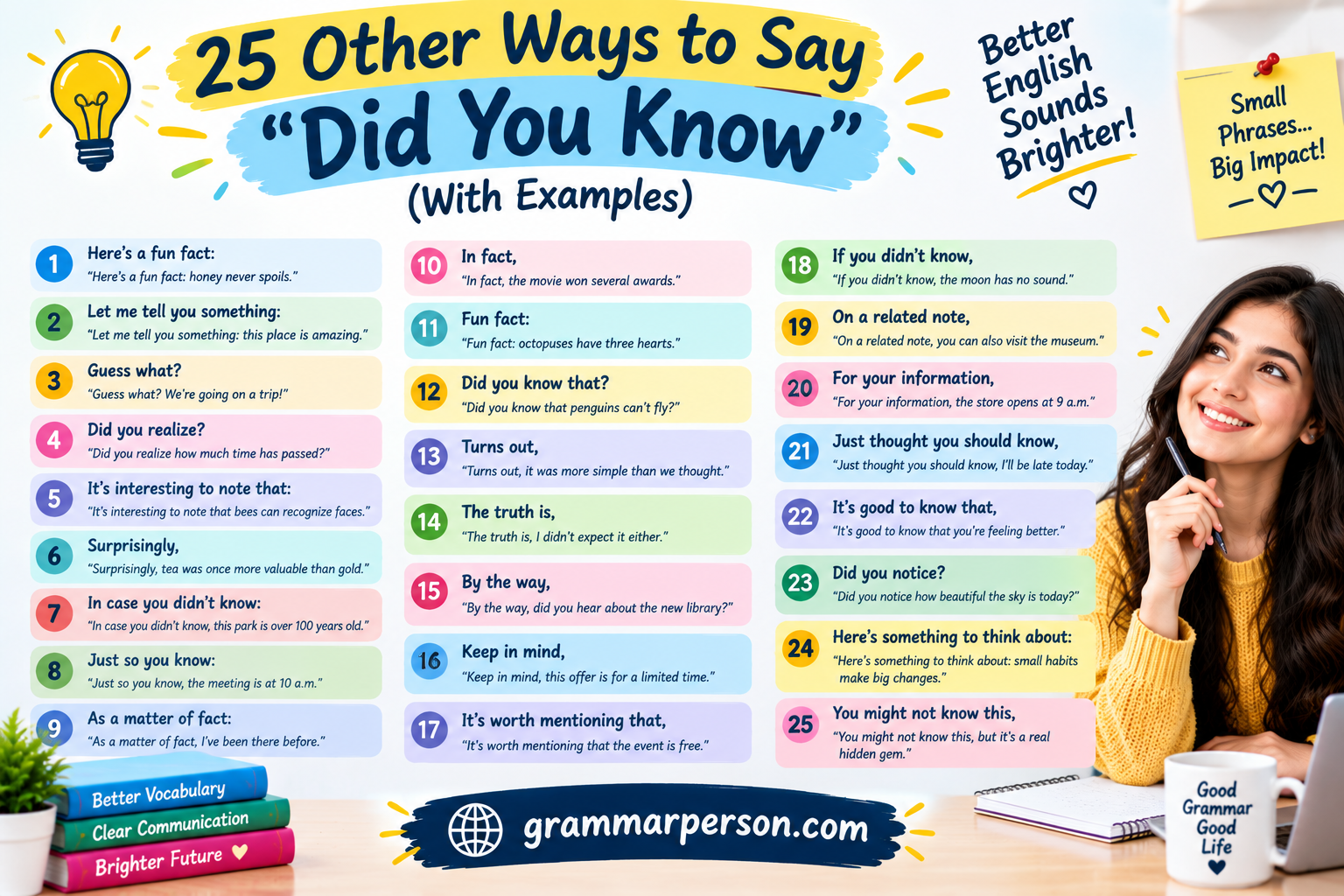
“Did you know” is a great way to grab attention before sharing an interesting fact — but if you use it in every paragraph, presentation, or social media post, it quickly loses its punch. Whether you’re writing content, giving a presentation, or just sharing something interesting with a friend, varying this phrase keeps your writing fresh and engaging.
This guide covers natural, professional, and casual alternatives to “did you know,” along with examples showing exactly when each one fits best.
What Does “Did You Know” Mean?
“Did you know” is a phrase used to introduce a fact, piece of trivia, or surprising piece of information. It’s designed to spark curiosity and grab the reader’s or listener’s attention before revealing something they likely didn’t already know.
Is “Did You Know” Professional or Polite to Use?
Yes, it’s widely used in both casual and professional settings, including presentations, articles, and educational content. That said, in formal writing or reports, phrases like “research shows” or “it’s worth noting” often sound more polished than the more conversational “did you know.”
Pros and Cons of Saying “Did You Know”
| Aspect | Details |
| Pros | Attention-grabbing, simple, works well in casual and educational content |
| Cons | Overused in blogs and social media, can feel repetitive |
| Best fix | Rotate between fact-based and curiosity-driven alternatives depending on tone |
Why You Need Alternatives to “Did You Know”
Repeating the same opener throughout an article, presentation, or conversation can make your content feel formulaic. Using alternatives helps you:
- Keep readers engaged instead of tuning out a familiar phrase
- Match the tone of your content — casual, formal, or playful
- Add variety across long-form articles or listicles
- Make each fact feel fresh and worth paying attention to
Tips for Choosing the Right Phrase
- Match the setting. “Research shows” fits formal writing; “fun fact” suits casual content.
- Vary phrasing across a piece. Don’t repeat the same alternative more than once or twice in a single article.
- Consider your audience. Playful phrases work for social media; professional tone suits reports.
- Keep it natural. Choose wording that flows smoothly into the fact that follows.
Complete List of Alternatives to “Did You Know”
| # | Alternative Phrase | Best Used In |
| 1 | Were you aware | General writing, presentations |
| 2 | Have you heard | Casual conversation, social posts |
| 3 | Fun fact | Blogs, social media |
| 4 | Here’s something interesting | Articles, listicles |
| 5 | It’s worth noting | Formal or academic writing |
| 6 | You might be surprised to learn | Engaging introductions |
| 7 | Research shows | Reports, formal content |
| 8 | Just so you know | Casual, conversational tone |
| 9 | In case you didn’t know | Informal writing |
| 10 | Believe it or not | Storytelling, blog posts |
| 11 | Here’s a little-known fact | Trivia, educational content |
| 12 | For your information | Semi-formal writing |
| 13 | It may surprise you that | Formal introductions |
| 14 | I recently learned that | Personal, conversational tone |
| 15 | Something worth knowing | General audience content |
| 16 | You may not be aware | Formal or instructional writing |
| 17 | Here’s a quick fact | Short-form content |
| 18 | It’s interesting to note | Academic or professional writing |
| 19 | Guess what | Playful, casual tone |
| 20 | An interesting observation | Analytical or research content |
1. Were You Aware
A slightly more formal alternative that still keeps the curiosity-driven tone intact. Example: “Were you aware that honey never spoils if stored properly?”
2. Have You Heard
A conversational opener that works well in casual writing or spoken content. Example: “Have you heard that the Great Wall of China isn’t visible from space?”
3. Fun Fact
A short, catchy phrase especially popular in blogs and social media content. Example: “Fun fact: octopuses have three hearts.”
4. Here’s Something Interesting
A smooth, versatile way to introduce a fact without sounding repetitive. Example: “Here’s something interesting — bananas are botanically classified as berries.”
5. It’s Worth Noting
A more formal alternative ideal for reports, essays, or professional writing. Example: “It’s worth noting that this policy applies only to new employees.”
6. You Might Be Surprised to Learn
A slightly longer phrase that builds anticipation before revealing the fact. Example: “You might be surprised to learn that sharks existed before trees.”
7. Research Shows
Best suited for data-driven or academic content where credibility matters. Example: “Research shows that short breaks improve overall productivity.”
8. Believe It or Not
A dramatic, engaging phrase often used in storytelling or blog introductions. Example: “Believe it or not, flamingos are born gray, not pink.”
9. In Case You Didn’t Know
A friendly, informal way to share information without sounding like a lecture. Example: “In case you didn’t know, coffee is technically a fruit seed.”
10. Here’s a Little-Known Fact
Great for trivia-style content or educational articles. Example: “Here’s a little-known fact: the Eiffel Tower can grow taller in summer heat.”
Formal vs. Casual Alternatives
| Formal (Reports, Articles) | Casual (Social Media, Conversations) |
| It’s worth noting | Fun fact |
| Research shows | Guess what |
| You may not be aware | Have you heard |
| It’s interesting to note | Believe it or not |
FAQs
What are other ways to say “did you know”?
Phrases like “fun fact,” “were you aware,” or “here’s something interesting” all work as natural, varied alternatives.
What’s a professional way to say “did you know”?
In formal writing, try “research shows” or “it’s worth noting” for a more polished, credible tone.
Why should I avoid repeating “did you know” in one article?
Repetition makes content feel monotonous; alternating phrases keeps readers engaged and curious throughout the piece.
Can these phrases be used in presentations?
Yes, phrases like “you might be surprised to learn” or “it’s interesting to note” work especially well when introducing facts in presentations.
Is “did you know” too casual for professional writing?
It’s not incorrect, but in formal reports or academic writing, alternatives like “research indicates” often sound more credible.
Conclusion
“Did you know” is a reliable, attention-grabbing phrase, but repeating it too often can make your content feel predictable. Alternatives like “fun fact,” “research shows,” or “here’s something interesting” let you keep readers curious while adding variety to your writing. Match the phrase to your tone — formal, casual, or playful — and your content will feel fresh with every new fact you share.

Mr Danish Ali is an English grammar enthusiast who creates clear, practical, and easy-to-understand content at GrammarPerson, helping learners improve grammar, writing, sentences, and communication skills.