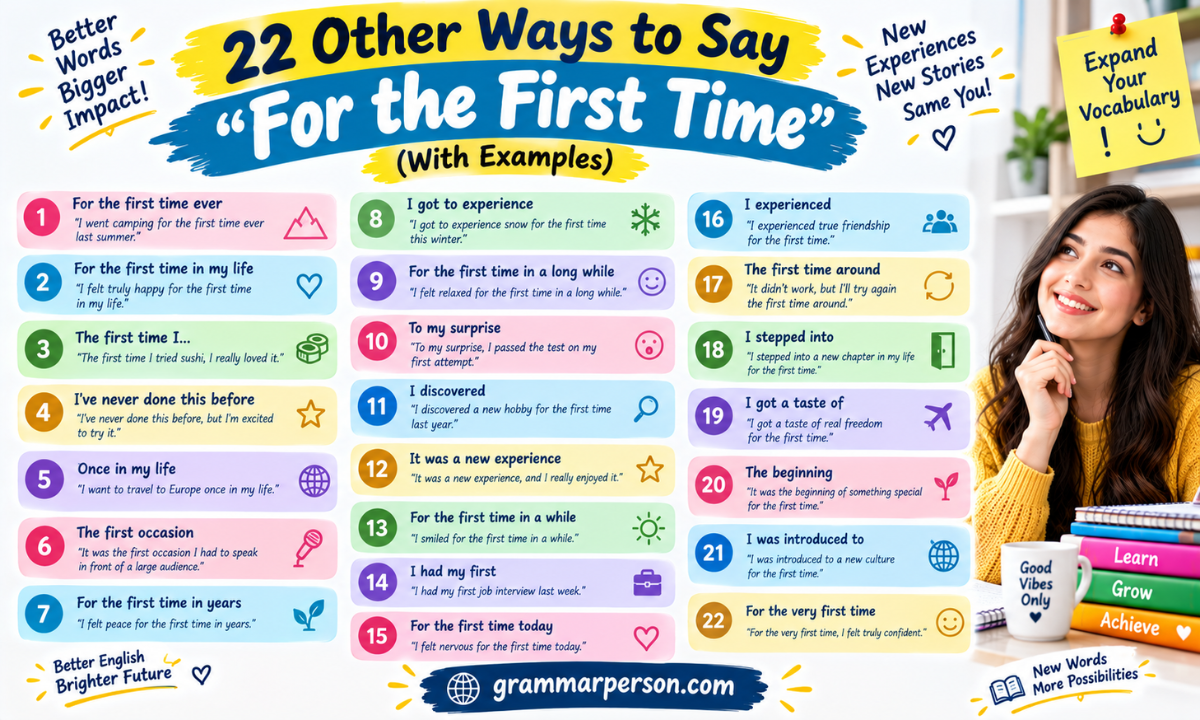
Looking for other ways to say “for the first time”? Explore 22 formal, casual, and expressive alternatives with clear examples to make your writing sound fresh and polished
For the first time” is a phrase we reach for constantly — in stories, resumes, reviews, and everyday conversation. But when it shows up in every other sentence, your writing starts to feel repetitive instead of engaging. Whether you’re writing a personal essay, a product review, or a professional report, varying this phrase adds polish and keeps readers interested.
This guide breaks down natural, formal, and expressive alternatives to “for the first time,” along with examples showing exactly when each one works best.
What Does “For the First Time” Mean?
“For the first time” describes something happening or being experienced initially, without any prior occurrence. It’s used to highlight a new experience, achievement, or event — whether it’s trying something new, visiting a place, or accomplishing a goal.
Is “For the First Time” Professional or Polite to Use?
Yes, it’s completely appropriate in both formal and casual writing. It’s commonly used in resumes, reports, and narratives to highlight milestones. That said, repeating it throughout longer pieces can make writing feel flat, which is why varying the phrase adds more depth and polish.
Pros and Cons of Saying “For the First Time”
| Aspect | Details |
|---|---|
| Pros | Clear, widely understood, works in formal and casual writing |
| Cons | Overused in storytelling and reports, can feel repetitive |
| Best fix | Rotate between formal and expressive alternatives depending on context |
Why You Need Alternatives to “For the First Time”
Relying on the same phrase throughout an entire piece can make even exciting content feel monotonous. Using alternatives helps you:
- Add variety to storytelling, essays, and reviews
- Match the tone of formal or expressive writing
- Highlight milestones with more emotional impact
- Sound more polished in professional documents
Tips for Choosing the Right Phrase
- Match the tone. “At the outset” suits formal writing; “for the very first time” fits storytelling.
- Consider the context. Use “on my first attempt” for personal achievements, and “from the outset” for professional writing.
- Avoid repetition. Rotate phrases throughout longer pieces of writing.
- Keep it natural. Choose wording that flows smoothly within the sentence.
Complete List of Alternatives to “For the First Time”
| # | Alternative Phrase | Best Used In |
|---|---|---|
| 1 | Initially | Formal writing, reports |
| 2 | At first | Casual writing, storytelling |
| 3 | At the outset | Business or academic writing |
| 4 | From the start | General narrative writing |
| 5 | On my first attempt | Personal achievements |
| 6 | At the beginning | Everyday conversation |
| 7 | Upon first experience | Reviews, personal essays |
| 8 | From day one | Casual, motivational tone |
| 9 | When I first tried | Personal storytelling |
| 10 | At the very start | General writing |
| 11 | On the first occasion | Formal or semi-formal writing |
| 12 | During my debut | Career or performance-related writing |
| 13 | At first glance | Descriptive, observational writing |
| 14 | For the very first time | Emotional or narrative storytelling |
| 15 | Upon first encounter | Formal descriptions |
| 16 | When it all began | Reflective, narrative tone |
| 17 | At the point of introduction | Technical or instructional writing |
| 18 | On my first try | Casual, personal tone |
| 19 | In its early moments | Descriptive storytelling |
| 20 | From square one | Informal, motivational tone |
| 21 | At the inaugural moment | Formal, ceremonial writing |
| 22 | As a new experience | Reflective, personal writing |
Read This Link: grammarperson.com
1. Initially
A clean, formal alternative commonly used in reports, essays, and professional writing. Example: “Initially, the results seemed inconclusive, but further testing confirmed the theory.”
2. At First
A simple, versatile phrase that works well in both formal and casual writing. Example: “At first, she was nervous about public speaking, but her confidence grew quickly.”
3. At the Outset
A polished, formal option ideal for business or academic writing. Example: “At the outset, the project faced several unexpected challenges.”
4. From the Start
A natural alternative that fits smoothly into narrative or descriptive writing. Example: “From the start, the team knew this project would be different.”
5. On My First Attempt
Perfect for personal writing that highlights individual achievements or experiences. Example: “On my first attempt, I managed to finish the marathon in under five hours.”
6. Upon First Experience
A slightly more formal phrase, ideal for reviews or reflective essays. Example: “Upon first experience, the restaurant exceeded all expectations.”
7. From Day One
A casual, motivational phrase often used in workplace or personal storytelling. Example: “From day one, she showed exceptional leadership skills.”
8. During My Debut
Common in career, performance, or achievement-focused writing. Example: “During my debut on stage, I forgot my lines for a brief moment.”
9. At First Glance
Useful for descriptive or observational writing, especially reviews. Example: “At first glance, the apartment seemed too small for our needs.”
10. When It All Began
A reflective, storytelling phrase that adds emotional depth to narratives. Example: “When it all began, none of us expected the business to grow this fast.”
Formal vs. Casual Alternatives
| Formal (Reports, Essays) | Casual (Conversations, Stories) |
|---|---|
| Initially | At first |
| At the outset | From day one |
| Upon first encounter | On my first try |
| At the inaugural moment | For the very first time |
FAQs
What is a formal way to say “for the first time”?
“Initially,” “at the outset,” and “from the outset” are strong formal alternatives commonly used in reports and academic writing.
What’s a more expressive alternative for storytelling?
Phrases like “for the very first time” or “when it all began” add emotional depth and work well in narrative writing.
Can “at first” replace “for the first time” in every sentence?
Not always — “at first” typically works better within a sentence, while “for the first time” often fits better at the end.
Why should I avoid repeating “for the first time” in one article?
Repetition makes writing feel monotonous; using varied phrases like “on my first attempt” keeps the content fresh and engaging.
Is “for the first time” appropriate in professional writing?
Yes, it’s widely accepted, but rotating with alternatives like “at the outset” adds more polish to formal documents.
Conclusion
“For the first time” is a clear, reliable phrase, but repeating it throughout your writing can make it feel flat. Alternatives like “initially,” “at the outset,” or “from day one” let you keep the same meaning while adding variety and depth to your content. Match the phrase to your tone — formal, casual, or expressive — and your writing will feel more engaging and polished.

Mr Danish Ali is an English grammar enthusiast who creates clear, practical, and easy-to-understand content at GrammarPerson, helping learners improve grammar, writing, sentences, and communication skills.