Looking for a fresher way to say “thank you for the clarification”? Here are 30 polite, professional, and casual alternatives with examples for emails, meetings, and chats.
Someone just cleared up a confusing instruction, a vague requirement, or a tricky point in a contract. You want to thank them. So you type, “Thank you for the clarification.”
It’s correct and it’s polite. But it’s also one of the most repeated lines in workplace email, and it often says less than you mean. It doesn’t show that you understood the answer or what you plan to do next.
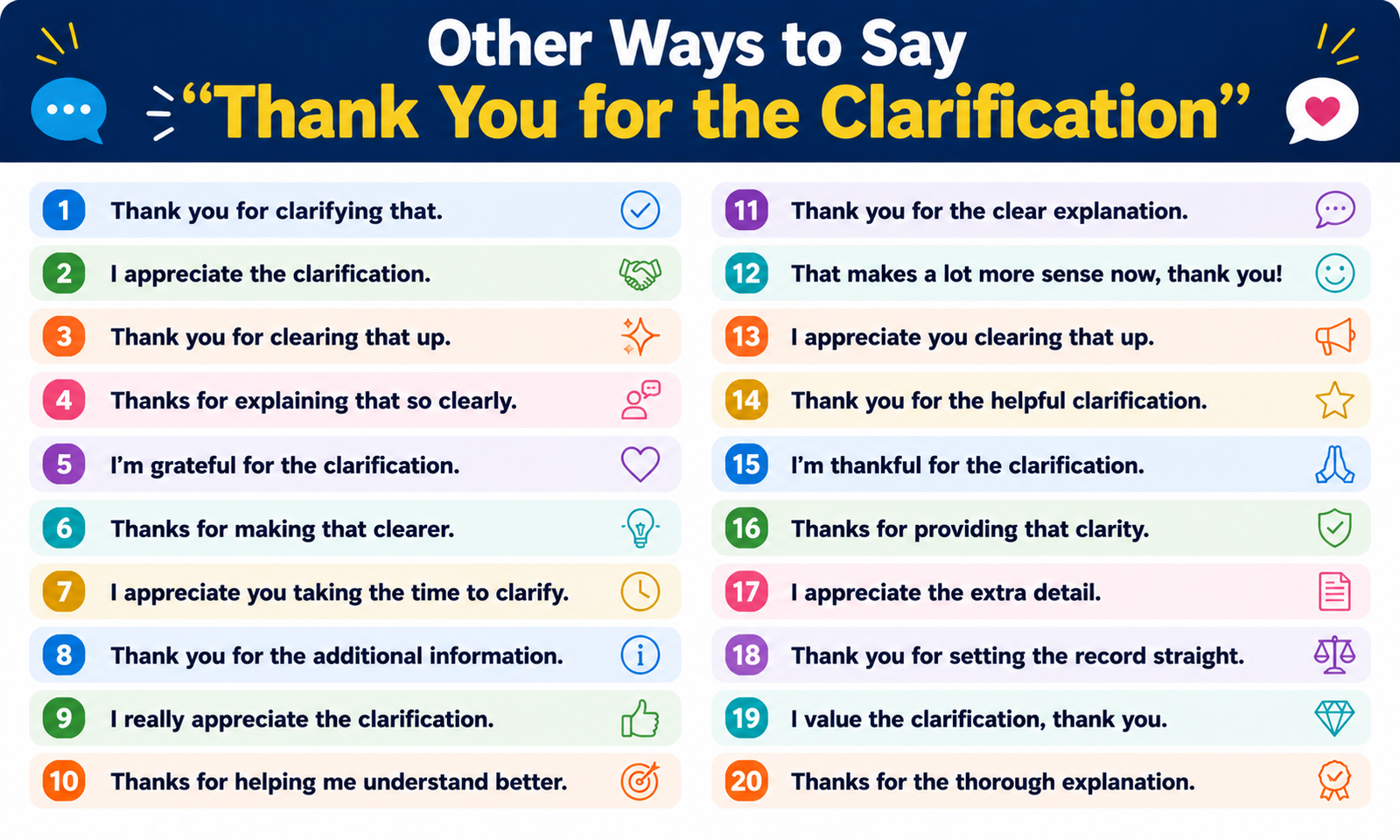
This guide gives you 30 alternatives to “thank you for the clarification.” They’re sorted by tone, with an example for each. You’ll also learn what the phrase means, how to use it correctly, and how to write a thank-you that moves the conversation forward.
What Does “Thank You for the Clarification” Mean?
“Thank you for the clarification” is a polite way to acknowledge that someone has explained something more clearly. It does two jobs:
- It expresses gratitude. You appreciate the time and effort they took.
- It signals closure. It tells them their explanation worked and the confusion is gone.
“Clarification” is a noun that means an explanation that removes doubt. Someone might clarify a deadline, a policy, an assignment, a price, a rule, or a statement that sounded ambiguous.
People use the phrase in emails, chats, meetings, classrooms, customer service, and legal or financial discussions. It fits any moment when a question was answered and you’re ready to move on.
Is It Professional to Say “Thank You for the Clarification”?
Yes. It’s polite, neutral, and safe in nearly every professional setting. You can use it with managers, clients, teachers, colleagues, and official contacts.
Still, a few points matter:
- It’s brief by design. On its own, it’s perfectly acceptable. But it may feel cold if the other person spent real effort helping you.
- Context adds warmth. “Thank you for clarifying the deadline” feels more personal than a generic line.
- Timing matters. A quick reply shows respect for the other person’s time.
- Requests for clarification can feel awkward. Some people worry they’ve shown a gap in knowledge. A friendly thank-you reassures them that asking was fine.
The phrase isn’t rude or wrong. The problem is that it’s often too generic to feel sincere, especially when you send it ten times a week.
Grammar Notes: Getting It Right
A few small points help your message look polished.
1. “Clarification” vs. “clarifying.”
“Thank you for the clarification” uses a noun. “Thank you for clarifying” uses a gerund (the -ing form of a verb). Both are correct.
2. Use “the” in most cases.
“Thank you for the clarification” sounds natural. “Thank you for clarification” without the article is understandable but a bit clipped. It also appears in some formal or headline-style writing.
3. Add the topic with “on,” “about,” or “regarding.”
- “Thank you for the clarification on the schedule.”
- “Thanks for the clarification about the invoice.”
- “I appreciate the clarification regarding the policy.”
4. No comma is needed.
Write “Thank you for the clarification.” A comma after “thank you” isn’t required here.
5. Spelling.
“Clarification” has one “r” and two “i”s: clar-i-fi-ca-tion. Don’t mix it up with “clarity.”
Why You Need Alternatives to “Thank You for the Clarification”
Using the same sentence every time creates a few problems.
- It can sound automatic. Readers sense when a phrase is just a reflex.
- It’s vague. It doesn’t tell the other person what became clear.
- It rarely confirms understanding. A good reply shows you got the point.
- It doesn’t suit every tone. A message to a client differs from a chat with a teammate.
- It misses a chance to build trust. A more specific thank-you encourages people to keep helping you.
Better wording also reduces back-and-forth. When you restate what you understood, the other person can correct you right away if something is off.
Pros and Cons of “Thank You for the Clarification”
| Pros | Cons | |
| Tone | Polite and professional | Can feel cold or formulaic |
| Clarity | Everyone understands it | Doesn’t show what you learned |
| Flexibility | Works in email, chat, and speech | May be too formal for friends |
| Safety | Rarely offends | Easy to overuse |
| Effort | Quick to type | Doesn’t confirm next steps |
Tips for Choosing the Right Phrase
Use these quick checks before you reply.
- Know the relationship. A boss, a client, and a teammate each expect a different tone.
- Match the channel. Formal email allows full sentences. Chat apps favor short lines.
- Be specific. Name the topic: “Thanks for clarifying the delivery date.”
- Confirm what you understood. A one-line summary shows you listened.
- State your next step. “I’ll update the draft today” shows action.
- Keep it concise. One or two sentences are enough. Long, flowery thank-yous can create extra reading for a busy person.
- Reply promptly. A fast acknowledgment shows respect.
- Stay sincere. Only use strong words like “invaluable” when they fit.
Quick formula: Thanks + what was clarified + what you’ll do next.
Example: “Thanks for clarifying the budget limit. I’ll revise the proposal by Friday.”
Quick Overview: All 30 Alternatives by Tone
| # | Phrase | Tone | Best For |
| 1 | Thank you for clarifying | Neutral | Everyday email |
| 2 | I appreciate the clarification | Professional | Work messages |
| 3 | Thank you for the additional information | Formal | Clients, officials |
| 4 | Thank you for explaining that | Neutral | General use |
| 5 | I appreciate you taking the time to clarify | Warm-professional | Busy contacts |
| 6 | Thank you for the detailed explanation | Formal | Complex topics |
| 7 | Many thanks for the clarification | Formal (UK) | Business emails |
| 8 | I’m grateful for your clarification | Formal | Senior contacts |
| 9 | Thank you for clearing that up | Friendly | Colleagues |
| 10 | Thank you for your prompt clarification | Professional | Fast replies |
| 11 | That clears things up. Thank you | Friendly-professional | Chat, email |
| 12 | Now I understand. Thank you | Neutral | Simple answers |
| 13 | Thank you for walking me through it | Warm | Step-by-step help |
| 14 | I appreciate your patience in explaining | Warm | After repeated questions |
| 15 | Thank you for the guidance | Professional | Managers, mentors |
| 16 | Thanks for the heads-up | Casual | Quick notes |
| 17 | Thanks for clearing that up | Casual | Teammates |
| 18 | Got it, thanks | Casual | Chat |
| 19 | That makes sense now. Thanks | Casual | Chat, email |
| 20 | Thanks for breaking that down | Casual-warm | Complex tasks |
| 21 | Thanks, that helps a lot | Casual | Everyday |
| 22 | Perfect, thanks for the explanation | Casual | Chat |
| 23 | Thanks for the clarity | Casual-professional | Slack, Teams |
| 24 | Thank you for setting me straight | Friendly | Corrections |
| 25 | I appreciate you making that clear | Warm | Any |
| 26 | Thank you for the context | Professional | Background info |
| 27 | Thank you for the quick explanation | Friendly | Short replies |
| 28 | Thanks. That’s exactly what I needed to know | Warm | Specific answers |
| 29 | Thank you. I’ll proceed accordingly | Formal | Instructions |
| 30 | Thanks for taking the time to explain | Warm | Anyone who helped |
Formal and Professional Alternatives (1–3, 6–8, 10, 15, 26, 29)
Use these in business email, client messages, and official communication.
1. Thank You for Clarifying
A natural, slightly shorter version. The verb form makes it feel more active.
- “Thank you for clarifying the submission format.”
- “Thank you for clarifying who approves the request.”
2. I Appreciate the Clarification
A widely used professional alternative. “Appreciate” adds a bit more warmth than “thank you” alone.
- “I appreciate the clarification on the contract terms.”
- “I appreciate the clarification. It helps a great deal.”
3. Thank You for the Additional Information
Good when the answer included extra details beyond the original question. It’s formal and neutral.
- “Thank you for the additional information about the policy.”
- “Thank you for the additional information. I’ll review it today.”
6. Thank You for the Detailed Explanation
Use this when someone gave a thorough answer. It recognizes the effort.
- “Thank you for the detailed explanation of the billing process.”
- “Thank you for the detailed explanation. It was very helpful.”
7. Many Thanks for the Clarification
Common in British and Commonwealth business writing. It sounds courteous and slightly more formal.
- “Many thanks for the clarification regarding the venue.”
- “Many thanks for the clarification. I’ll update the team.”
8. I’m Grateful for Your Clarification
Stronger and more formal. Best for senior contacts or important matters.
- “I’m grateful for your clarification on the legal terms.”
- “I’m grateful for your clarification. It resolves my main concern.”
10. Thank You for Your Prompt Clarification
This one praises speed as well as help, which works well if you were on a tight deadline.
- “Thank you for your prompt clarification on the shipping date.”
- “Thank you for your prompt clarification. I can proceed now.”
15. Thank You for the Guidance
Fits mentors, managers, and experts. It suggests the person helped you steer your work.
- “Thank you for the guidance on the reporting format.”
- “Thank you for the guidance. I’ll follow that approach.”
26. Thank You for the Context
Good when the explanation involved background that changed how you saw the task.
- “Thank you for the context. It explains the change in priorities.”
- “Thank you for the context behind the decision.”
29. Thank You. I’ll Proceed Accordingly
Formal and action-focused. It tells the other person you’ll act on the information.
- “Thank you for the update. I’ll proceed accordingly.”
- “Thank you for confirming. I’ll proceed accordingly.”
Warm and Friendly Alternatives (4, 5, 9, 11–14, 24, 25, 27, 28, 30)
These keep a professional edge but sound more human.
4. Thank You for Explaining That
Simple and gentle. It works whenever someone took a moment to talk you through something.
- “Thank you for explaining that. I was confused about the deadline.”
- “Thank you for explaining that so clearly.”
5. I Appreciate You Taking the Time to Clarify
This shows you value the other person’s time, which matters when they’re busy.
- “I appreciate you taking the time to clarify the process.”
- “I appreciate you taking the time to clarify, especially today.”
9. Thank You for Clearing That Up
A relaxed but polite phrase. It’s good for colleagues you know well.
- “Thank you for clearing that up. I was reading it the wrong way.”
- “Thank you for clearing that up before the meeting.”
11. That Clears Things Up. Thank You
This phrase confirms the clarification worked. It’s friendly and efficient.
- “That clears things up. Thank you for the quick reply.”
- “That clears things up. Thank you.”
12. Now I Understand. Thank You
Direct and honest. It shows the explanation succeeded.
- “Now I understand the process. Thank you.”
- “Now I understand why we changed it. Thank you.”
13. Thank You for Walking Me Through It
Perfect when the person explained step by step. It acknowledges the extra effort.
- “Thank you for walking me through the setup.”
- “Thank you for walking me through it. I feel confident now.”
14. I Appreciate Your Patience in Explaining
Use this after asking several follow-up questions. It recognizes that you took up their time.
- “I appreciate your patience in explaining the policy.”
- “I appreciate your patience in explaining this twice.”
24. Thank You for Setting Me Straight
Friendly and honest. It works when you had a wrong assumption.
- “Thank you for setting me straight on the process.”
- “Thank you for setting me straight. I’ll fix the draft.”
25. I Appreciate You Making That Clear
A warm, flexible phrase. It credits the other person’s skill at explaining.
- “I appreciate you making that clear. It saves me a lot of time.”
- “I appreciate you making that clear for the whole team.”
27. Thank You for the Quick Explanation
Good when the reply was short but helpful. It also thanks them for being fast.
- “Thank you for the quick explanation. That’s all I needed.”
- “Thank you for the quick explanation about the form.”
28. Thanks. That’s Exactly What I Needed to Know
Warm and specific. It tells the person their answer hit the mark.
- “Thanks. That’s exactly what I needed to know.”
- “Thanks. That’s exactly what I needed to know before the call.”
30. Thanks for Taking the Time to Explain
Heartfelt and simple. Ideal for teachers, mentors, and anyone who gave real effort.
- “Thanks for taking the time to explain the grading rubric.”
- “Thanks for taking the time to explain. It makes a big difference.”
Casual Alternatives (16–23)
Use these with friends, close teammates, or in quick chat apps.
16. Thanks for the Heads-Up
Good when the clarification also warned you about something.
- “Thanks for the heads-up about the new format.”
- “Thanks for the heads-up. I’ll adjust.”
17. Thanks for Clearing That Up
A relaxed, everyday phrase. It’s quick and friendly.
- “Thanks for clearing that up.”
- “Thanks for clearing that up. Makes much more sense.”
18. Got It, Thanks
The shortest option. It works for fast chat replies where a long message would feel excessive.
- “Got it, thanks.”
- “Got it, thanks. I’ll send it over.”
19. That Makes Sense Now. Thanks
A casual confirmation. It shows you followed the explanation.
- “That makes sense now. Thanks!”
- “That makes sense now. Thanks for the reply.”
20. Thanks for Breaking That Down
Perfect for complicated topics. It credits the person for simplifying something hard.
- “Thanks for breaking that down. It was confusing on paper.”
- “Thanks for breaking that down step by step.”
21. Thanks, That Helps a Lot
Friendly and sincere. It focuses on the benefit to you.
- “Thanks, that helps a lot.”
- “Thanks, that helps a lot with the planning.”
22. Perfect, Thanks for the Explanation
Casual and positive. Use it when the answer resolved the issue completely.
- “Perfect, thanks for the explanation.”
- “Perfect, thanks for the explanation. All set.”
23. Thanks for the Clarity
Short and modern. It works well in team chat tools.
- “Thanks for the clarity on the next steps.”
- “Thanks for the clarity. We’re good to go.”
Which Phrase Fits Which Situation?
| Situation | Best Options |
| Email to a client | Thank you for the additional information / I appreciate the clarification |
| Message to your manager | Thank you for the guidance / Thank you for your prompt clarification |
| Reply to a teacher or professor | Thanks for taking the time to explain / I’m grateful for your clarification |
| Team chat (Slack, Teams) | Got it, thanks / Thanks for clearing that up |
| After a long meeting | Thank you for walking me through it |
| Legal or financial query | I appreciate the clarification regarding… / Thank you. I’ll proceed accordingly |
| Customer support | Thank you for explaining that / Thanks, that helps a lot |
| Repeated questions | I appreciate your patience in explaining |
| Correction of a mistake | Thank you for setting me straight |
Sample Emails You Can Copy and Adapt
Specific replies work better than generic ones. Here are three short templates.
Email to a manager:
“Hi Sara, thank you for clarifying the reporting deadline. I’ll send the first draft by Wednesday and the final version on Friday.”
Email to a client:
“Dear Mr. Khan, I appreciate the clarification on the delivery terms. To confirm, shipping starts on the 15th and includes insurance. I’ll arrange the payment accordingly.”
Message to a colleague:
“Thanks for breaking that down, Ali. That makes sense now. I’ll update the spreadsheet today.”
Notice the pattern: each one thanks the person, repeats the key point, and states the next action.
How to Confirm Understanding After a Clarification
Sometimes the best thank-you includes a quick restatement. It reduces errors and gives the other person a chance to correct you.
Try these openers:
- “To confirm my understanding, the deadline is Friday at noon.”
- “So, if I understand correctly, we only need the summary page.”
- “Just to make sure I have this right, approvals go through finance first.”
Keep it to one sentence. The goal is to close the loop without adding extra work for the other person.
How to Respond When Someone Thanks You for the Clarification
If someone thanks you, a short, warm reply works best.
- “You’re welcome. Let me know if anything else is unclear.”
- “Happy to help.”
- “Anytime. Feel free to ask again.”
- “Glad that helped.”
- “No problem at all.”
You can also offer a next step: “Happy to help. I’ll send the updated file this afternoon.”
Common Mistakes to Avoid
- Over-thanking. Three sentences of gratitude for a one-line answer can feel excessive.
- Being too vague. “Thanks for that” doesn’t say what you understood.
- Sounding sarcastic. “Thanks for the clarification” can sound passive-aggressive if you’re annoyed. Watch your tone, especially in text.
- Skipping the reply. Silence after someone helps you can look careless.
- Mixing formal and slang. “Dear Sir, thanks for clearing that up, mate” sounds odd.
- Using clarification for everything. Not every answer is a “clarification.” Sometimes “update,” “guidance,” or “explanation” is the better word.
- Forgetting the next step. If action is required, say what you’ll do.
When “Thank You for the Clarification” Can Sound Sarcastic
Tone is hard to read in writing. In a tense conversation, this phrase can come across as a polite jab, as though you’re saying, “That should have been clear from the start.”
To avoid that:
- Add warmth: “Thank you so much for clarifying. That really helps.”
- Be specific: “Thanks for clarifying the budget cap.”
- Skip it if you’re frustrated and need to cool down before replying.
A sincere tone and a clear next step usually prevent misunderstandings.
FAQs
1. Is “thank you for the clarification” professional?
Yes. It’s polite, neutral, and widely accepted in workplace emails and formal communication.
2. Is it “clarification” or “clarifying”?
Both work. “Thank you for the clarification” uses a noun, and “thank you for clarifying” uses a verb form.
3. What is a more formal alternative?
Try “I appreciate the clarification” or “I’m grateful for your clarification.” Both suit senior or official contacts.
4. What is a casual way to say it?
“Got it, thanks” or “Thanks for clearing that up” fit chats and relaxed teams.
5. How can I make my thank-you sound more sincere?
Name the topic and add your next step, like “Thanks for clarifying the deadline. I’ll finish by Friday.”
6. Should I always reply after someone clarifies something?
Yes, a short acknowledgment is polite. It also confirms that the explanation worked.
7. Can “thank you for the clarification” sound rude?
It can sound sarcastic if you’re frustrated. Add a warm word or a specific detail to keep it friendly.
8. What should I say if I still don’t understand?
Say “Thank you. Could you explain the second step once more?” This shows appreciation and invites further help.
Conclusion
“Thank you for the clarification” is a good phrase, but it’s only one option. With 30 alternatives, you can match your tone to the situation, whether you’re writing to a client, a manager, a teacher, or a teammate.
The strongest thank-you messages do more than say thanks. They name what was clarified, show you understood it, and state what you’ll do next. Keep it short, keep it honest, and reply promptly. Do that, and people will be glad to help you again.

Mr Danish Ali is an English grammar enthusiast who creates clear, practical, and easy-to-understand content at GrammarPerson, helping learners improve grammar, writing, sentences, and communication skills.