
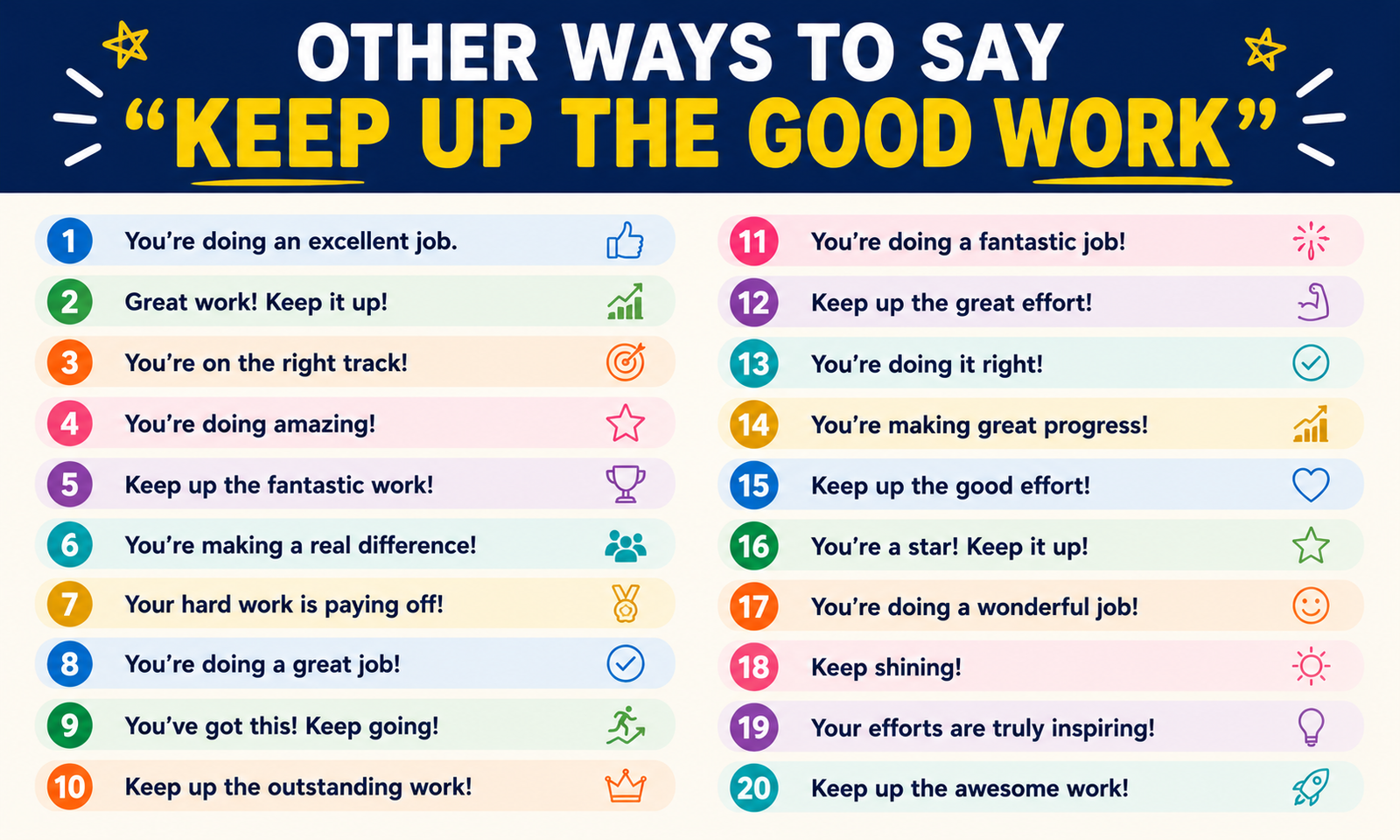
Tired of repeating “keep up the great work”? Here are 20 fresh, polite alternatives with real examples for emails, reviews, and chats.
You’ve probably typed “keep up the great work” more times than you can count. It’s friendly and safe, and it shows up in nearly every email, review, and chat message that praises someone.
The trouble is that safe phrases get stale. When a colleague hears the same line from you every month, it stops feeling like praise. It starts feeling like a habit.
This guide gives you 20 fresh alternatives to “keep up the great work.” Each one comes with a short note on when to use it and a ready-made example. You’ll also learn what the phrase means, whether it’s professional, and how to pick the right words for the moment.
What Does “Keep Up the Great Work” Mean?
“Keep up the great work” is a phrase of praise and encouragement. It tells someone two things at once:
- Their work is already excellent.
- You want them to continue at the same level.
The verb phrase “keep up” means to continue doing something without letting the quality drop. So you’re not just saying “good job.” You’re saying “good job, and please don’t stop.”
Managers, teachers, coaches, and team leads use it often. Friends and parents use it too. It works as a quick form of positive reinforcement because it recognizes effort and motivates the person to carry on.
Is It Professional/Polite to Say “Keep Up the Great Work”?
Yes. It is polite and professional in nearly every setting. It’s positive, respectful, and free of slang, so it fits in emails, meetings, and written feedback.
That said, tone and context matter:
- From a manager to an employee: Perfectly fine. It signals approval.
- From an employee to a manager: Can sound slightly patronizing, as if you’re grading your boss. Choose a phrase like “I really appreciate your leadership” instead.
- Between peers: Friendly and natural.
- In formal reports or performance reviews: Acceptable, but weak on its own. Add specific details.
The phrase isn’t rude. The risk is that it sounds generic. Praise with no details can feel like a formality, and people can tell when you didn’t really look at their work.
Why You Need Alternatives for “Keep Up the Great Work”
Using one phrase over and over has real costs.
- It loses impact. Repeated praise feels automatic. People stop hearing it.
- It lacks specifics. The phrase doesn’t say what the person did well, so it gives them nothing to repeat.
- It doesn’t fit every mood. A casual chat, a formal review, and a text to a friend all need different tones.
- It can sound dismissive. A quick “keep up the great work” tacked on at the end of a long message may feel like a brush-off.
- Variety shows care. Choosing your words signals that you noticed the person’s actual effort.
Better wording supports employee motivation, strengthens workplace culture, and helps people feel seen. It takes only a few extra seconds.
Advantages and Disadvantages of Saying “Keep Up the Great Work”
Here’s a quick look at both sides.
| Advantages | Disadvantages | |
| Tone | Warm and positive | Can feel scripted |
| Clarity | Easy for anyone to understand | Vague about what was good |
| Use | Works in most settings | Overused in business writing |
| Effect | Encourages continued effort | May not motivate when repeated |
Advantages:
- Instantly understood. No one needs a translation.
- Safe and polite. It rarely offends anyone.
- Motivating. It gives a quick boost and shows you’re paying attention.
- Flexible. It works in speech, email, chat, and cards.
- Quick to write. Handy when you’re busy.
Disadvantages:
- Generic. It doesn’t name the achievement.
- Overused. Many people hear it daily and ignore it.
- Can sound top-down. It sometimes carries a “boss to subordinate” feel.
- Low emotional depth. It doesn’t express gratitude, pride, or admiration.
- May ignore struggle. If someone is working hard but still behind, it can feel tone-deaf.
Tips for Choosing the Right Phrase
Use these quick rules to match your words to the moment.
- Know your audience. A new intern needs warmth. A senior director needs respect.
- Match the setting. “You’re nailing it” suits a team chat. “Exceptional performance” suits a review.
- Be specific when you can. Add a short detail: “Excellent job on the client report. The charts made it so clear.”
- Match the size of the win. Don’t call a routine task “extraordinary.” Inflated praise sounds fake.
- Think about timing. Praise given soon after the work feels sincere.
- Read the person. Some people like public recognition. Others prefer a private note.
- Keep it honest. Only say what you mean.
Quick formula: Praise word + what they did + why it mattered.
Example: “Great job on the presentation. It helped us win the pitch.”
Full List of Alternatives
Here’s a quick map of all 20 phrases by tone, before the details.
| # | Phrase | Tone | Best For |
| 1 | Excellent Job | Professional | Emails, reviews |
| 2 | Outstanding Work | Formal | Reports, awards |
| 3 | Fantastic Effort | Warm | Team updates |
| 4 | Great Job | Neutral | Everyday use |
| 5 | Keep It Up | Casual | Chats, coaching |
| 6 | You’re Doing Amazing | Friendly | Peers, friends |
| 7 | Admirable Work | Formal | Senior colleagues |
| 8 | Exceptional Performance | Formal | Performance reviews |
| 9 | Well Done | Neutral | All settings |
| 10 | Bravo | Playful | Celebrations |
| 11 | You’re Nailing It | Casual | Ongoing projects |
| 12 | Keep Rocking | Casual | Close teams |
| 13 | Top-Notch Work | Professional | Quality checks |
| 14 | Remarkable Job | Formal | Big milestones |
| 15 | Keep Shining | Warm | Students, juniors |
| 16 | Hats Off to You | Warm | Special effort |
| 17 | Keep Excelling | Professional | High performers |
| 18 | Fantastic Achievement | Formal | Goals reached |
| 19 | Keep Thriving | Warm | Long-term growth |
| 20 | You’re Inspiring | Personal | Mentors, leaders |
1. Excellent Job
A clean, professional choice. It works well when someone has finished a task to a high standard. It’s short, clear, and fits both email and conversation.
Examples:
- “Excellent job on the quarterly summary. The numbers were easy to follow.”
- “Excellent job handling that customer complaint. You stayed calm the whole time.”
2. Outstanding Work
This phrase says the work stood out from the rest. Use it when quality is clearly above average. It suits formal writing, awards, and written feedback.
Examples:
- “Outstanding work on the audit. You caught errors no one else noticed.”
- “Your design was outstanding work. The client loved every detail.”
3. Fantastic Effort
This one praises the effort rather than the result. It’s useful when someone tried hard, even if the outcome wasn’t perfect. It encourages persistence.
Examples:
- “Fantastic effort this week. I know the deadline was tight.”
- “That was a fantastic effort from the whole team during the launch.”
4. Great Job
Simple and friendly. It works almost anywhere. Because it’s so common, add a detail to make it count.
Examples:
- “Great job on the workshop. People are still talking about it.”
- “Great job finishing the project early.”
5. Keep It Up
A shorter, more casual cousin of “keep up the great work.” It’s a good fit for coaching and quick chats, and it carries the same encouraging meaning.
Examples:
- “Your sales numbers look strong. Keep it up.”
- “You’ve improved so much this month. Keep it up.”
6. You’re Doing Amazing
This one is warm and personal. It focuses on the person rather than the task. It’s good for peers, friends, and anyone who may need a lift.
Examples:
- “You’re doing amazing with the new role. It’s not easy to adjust that fast.”
- “I know it’s been hectic, but you’re doing amazing.”
7. Admirable Work
“Admirable” conveys respect. Use it when the person showed integrity, patience, or care along with skill. It reads as more thoughtful than “great.”
Examples:
- “Admirable work in resolving the conflict between those two teams.”
- “It was admirable work staying late to help the new hires.”
8. Exceptional Performance
A strong, formal phrase for top results. It belongs in performance reviews, recommendation letters, and official recognition. Save it for truly standout work.
Examples:
- “Your exceptional performance this year helped us exceed every target.”
- “She delivered exceptional performance under heavy pressure.”
9. Well Done
Classic and polite. “Well done” works for all ages and settings, and it has a slightly formal, respectful feel.
Examples:
- “Well done on passing the certification exam.”
- “Well done. The final report was clear and complete.”
10. Bravo
A fun, expressive option. It suits celebrations, creative work, and cheerful messages. Don’t use it in serious or very formal writing.
Examples:
- “Bravo on the performance. The audience loved it.”
- “Bravo! That was a smart solution to a tricky problem.”
11. You’re Nailing It
Casual and energetic. It tells someone they’re doing exactly what’s needed, right now. It’s best for ongoing work rather than finished projects.
Examples:
- “You’re nailing it with these client calls.”
- “You’re nailing it as the new team lead.”
12. Keep Rocking
Very informal and high-energy. Use it with close teammates, friends, or younger colleagues. Skip it in formal emails.
Examples:
- “Thanks for covering the shift. Keep rocking!”
- “The new video is awesome. Keep rocking.”
13. Top-Notch Work
This phrase signals first-rate quality. It’s professional but not stiff, so it suits quality reviews, creative work, and technical tasks.
Examples:
- “Top-notch work on the code review. Very clean and well documented.”
- “The report was top-notch work from start to finish.”
14. Remarkable Job
“Remarkable” means worth noticing. Use it for big milestones or unexpected success. It adds weight to your praise.
Examples:
- “That was a remarkable job turning the project around in two weeks.”
- “A remarkable job, considering the limited budget.”
15. Keep Shining
This is a warm, encouraging phrase. It works well for students, newer team members, and anyone building confidence. It adds a gentle, human touch.
Examples:
- “Your progress this term has been wonderful. Keep shining.”
- “You’ve grown so much in this role. Keep shining.”
16. Hats Off to You
An old-fashioned expression of respect. It suits moments when someone went beyond the call of duty. It feels sincere and a bit celebratory.
Examples:
- “Hats off to you for managing the event so smoothly.”
- “Hats off to you. Few people could have handled that situation.”
17. Keep Excelling
A professional phrase that keeps the “continue” meaning of the original. It suits high performers who already deliver strong results.
Examples:
- “Your results are impressive. Keep excelling.”
- “You’ve set a high standard for the department. Keep excelling.”
18. Fantastic Achievement
This one celebrates a completed goal. Use it for promotions, sales targets, degrees, and finished projects. It marks the moment as significant.
Examples:
- “Closing that deal was a fantastic achievement.”
- “Congratulations on your degree. What a fantastic achievement.”
19. Keep Thriving
A positive, forward-looking phrase. It suggests growth, not just output. It fits mentoring, long-term development, and personal messages.
Examples:
- “You’ve adapted beautifully to the new team. Keep thriving.”
- “It’s wonderful to see you doing so well. Keep thriving.”
20. You’re Inspiring
The most personal option on this list. It tells someone their example affects others. Use it sincerely and sparingly, because it carries real emotional weight.
Examples:
- “Your dedication to the team is inspiring.”
- “You’re inspiring everyone around you with your consistency.”
FAQs
1. Is “keep up the great work” rude?
No. It’s polite and positive. It can feel generic or slightly top-down if you use it too often.
2. What is a good reply when someone says “keep up the great work”?
Say “Thank you, I appreciate that” or “Thanks, that means a lot.” Add a short note, like “I’ll keep pushing,” to sound warm.
3. Which alternative is best for a performance review?
“Exceptional performance” or “outstanding work” fit best. Pair them with a specific example so the praise feels earned.
4. Can I use casual phrases like “keep rocking” at work?
Only with close colleagues and in relaxed settings. Choose “excellent job” or “well done” for formal messages.
5. Does changing phrases really improve motivation?
Yes. Specific, varied praise feels more sincere, and people are more likely to remember it and repeat the behavior.
Conclusion
“Keep up the great work” isn’t a bad phrase. It’s just a tired one when it’s the only phrase you use. The 20 alternatives above give you a range of tones, from formal (“exceptional performance”) to playful (“bravo”) to deeply personal (“you’re inspiring”).
The best praise is specific, honest, and timely. Name what the person did, say why it mattered, and pick words that fit your relationship with them. Do that, and even a short message will land. Next time you reach for the usual line, try one of these instead, and see how differently it’s received.

Mr Danish Ali is an English grammar enthusiast who creates clear, practical, and easy-to-understand content at GrammarPerson, helping learners improve grammar, writing, sentences, and communication skills.